
#ThrowbackThursday: The Time 20yo Heather taught on the Armor of God

lessons

Last week I gave my intern, Zach, an especially difficult lesson that he was to write from scratch and then I would watch him teach (this was the first time for either in a very long time): The Armor of God.

I forgot how difficult that passage was, and last week when I sat down with him to talk about it, I wanted to show him how taught on it when was his age. Except it would be a lesson of What Not to Do.

The Armor of God was the first curriculum series I ever wrote. I was 20 at a small Southern Baptist church and only halfway through my youth ministry degree. You can already tell this won’t turn out well.

I am so grateful that this church trusted me to lead their youth group. Really. But I look back at the things “20 year old Heather” did in ministry and LAUGH. This church allowed me the space to us their students as guinea pigs. I’m happy to say that they all have turned out to be functioning young college students, but that’s because they had a really great community to support them.

So, here are 7 things about that series that I did that is kind of silly. I dug through pictures.

1. I took this series and drug it out over 12 weeks. Yep.

2. I creatively had them create “armor” out of things I found in my dorm’s recycling bin.

72790_1480697619555_3791981_n

3. And made them fight.

67208_1480696899537_2905012_n.jpg

4. I taught them that the belt of truth was for chastity. So, they created “belts” that covered everything. Look above.

5. I created an armor guy out of poster board and added a piece to him each week. HE hung up in there for the next two years.196512_1669217652438_6213234_n.jpg

notice how I added extra papers on “the armor of God.”

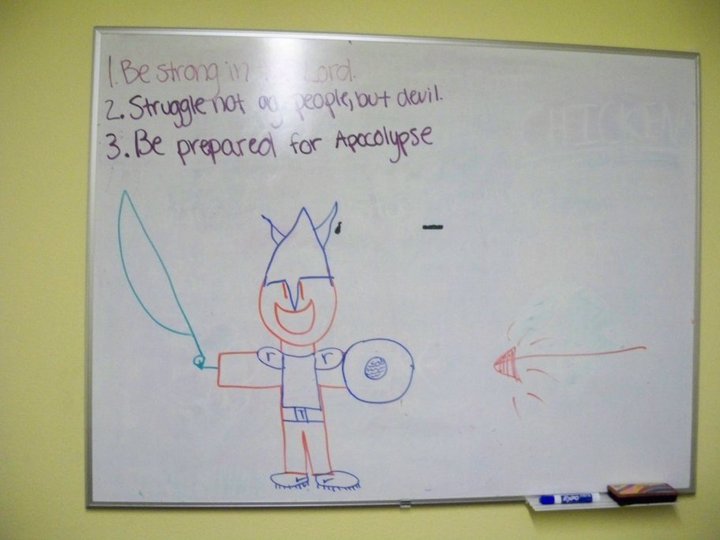
6. I actually wrote on the board “Be prepared for the apocalypse.”66969_1472194286977_3206936_n.jpg
7. This was a good part: I had them take the armor of God and get creative, drawing their own.75697_1507400007098_8201961_n.jpg

The boys drew a riot cop. The girls drew a conductor.

I’m sure that in 5 more years, I’ll laugh at 26-year old Heather. But for now, it’s fun looking at these pictures and remembering how God used a newbie in ministry to create a fun atmosphere and great dialogue with students who were probably smarter than I was. And as I coach newbies in ministry now, I can assure them with history to back me that God can use you even if you get it wrong.

What are You Fishing For?

christianity, church, Culture, Evangelicalism, lessons, lgbtq, politics, Theology

When Jesus first called his disciples, they were fishing. Jesus performed the miracle of filling their nets, proving that he was able to provide for their physical (and even financial) needs. Then Jesus said, “Follow me, and I’ll make you a fisher of men.”

These men followed Jesus on a three-year long journey. During this journey, Jesus performed many more miracles and even equipped the disciples to perform miracles of their own. They fed crowds, healed the sick, partied with the poor, and ate with sinners. Slowly, they discovered that Jesus was the Son of God, and Jesus equipped them to truly be “fishers of men.”

But when Jesus died, what happened?

In John chapter 21, Peter says to the disciples, “I’m going fishing.” And the rest of the disciples go with him. Even though Jesus has appeared to them twice thus far after his resurrection, they go back to life as if the last three years didn’t happen. They go fishing. For fish.

And so Jesus does his classic “Jesus thing,” paralleling that first time he calls them. 100 yards from shore, the fog-hidden Jesus tells them to cast their nets out on the other side. The disciples miraculously fill their nets and are unable to haul it to shore.

And Peter does his classic “Peter thing,” and jumps into the sea because he knows that Jesus is alive indeed. Jesus makes Peter go grab the net (because of course Peter left the disciples to do it), and there are 153 fish inside this net. A net that didn’t break.

Scholars say that at the time, there were only 153 species of fish known in the world.

Biblical scholars say that this net–the net that didn’t break–is representative of the Church. The 153 fish represent the different types of people in the world. When the disciples were trying to go back to just “fishing for fish,” Jesus had bigger plans to show them why they are to continue “fishing for men.”

The net is big enough for everybody. No longer is the net confined to one type of person. Everybody is allowed.

What does this mean for the Church today?

Who are the fish that we are excluding from the net, that perhaps need the safety and comfort of the net? Why are we creating an “insiders vs outsiders” mentality in the church, when all of us were made in the precious image of God? We all deserve the net equally, and the fisherman shouldn’t discriminate from who he allows to be a part of the Church.

What is the baggage that we think will exclude us from the net? You see, the net can hold it all without breaking. It can hold all of your doubts, insecurities, sins, shortcomings, failures, successes, and anything else. Being a certain type of fish doesn’t get you tossed back into the sea.

Why are we not united like the net? One net, 153 fish. This is the Kingdom of God. This is the one net that can hold it all and won’t break. This is the one net that can hold you, me, your crazy uncle, and the person in the office next to you, the rude lady who flipped you off in traffic, your ex-boothang, that person on Facebook who has political views that make you want to hurl, your neighbor whose family looks different from yours, your landlord, and Taco Bell employees at 3am.

I’m so thankful to be a part of a congregation that acknowledges that we are all so incredibly different, but it’s one Kingdom that holds us all.

What are you fishing for? Are you freely fishing for men, all men? Or are you acting as if the resurrection never happened, and you’re back to exclusively fishing for fish?

On Demon Pigs

christianity, lent, millennials

I’m beginning to gain a reputation as the youth minister who tells her tweens really weird stories.

And I’m okay with that.

This week in our Lenton series we told the story of Jesus taking the disciples to Decapolis and curing men there of demons by casting them into pigs that go flailing off the cliff.

I made all of our 5th-7th graders pinky promise me that we wouldn’t get caught up on the “demons” portion of the story, but that instead we would focus on why Jesus would take the disciples to Decapolis (which is the purpose of this particular series–why does Jesus take us these places?). Decapolis was a place Jews weren’t supposed to go, as evidenced by the pigs there. But why would Jesus take them to that place?

Jesus took them to that place because he wanted to show the disciples that they could leave a potential anywhere. That place was unfamilar, a place unlike any place they’ve ever experienced before. But faith with God takes us to those places that were unfamiliar so that on one hand our hearts can be softened for that environment and learn from it…but also so that we can impact those places in the same way that we’ve been impacted.

As I processed this with my small group, I thought about places in my life that were unfamiliar, places that I was unaware of the possibility of potential. I usually jump to when I began college–I was this poor city kid in an affluent rural school, trying to figure out friends who went “mudding” for fun. I put up a wall between myself and others because I didn’t think that we would understand each other. But I learned a lot about community with people who came from all kinds of different backgrounds as me.

But I think I forgot about this. Or at least, didn’t associate it to what I’m experiencing now: Moving my life to Indianapolis has been extremely difficult. It’s been difficult to find community. I thought that was because I was in an environment where I no one could possibly understand me. There’s a lot of affluency in this culture, and I thought that they wouldn’t get me. I thought they wouldn’t understand my background. Or my humor. Or my pain. Or me.

But in a sense, it’s like when I went to college and explored a new culture. The thing that excited me when I moved to Indianapolis was the possibility of doing faith in a brand new way. But I didn’t realize that I was going to have to do community in a brand new way.

I think the biggest hurdle isn’t finding people who are like me. It’s finding people who want to do messy community with me. I’ve always been in places where people lay their junk out in the open. We weren’t the same, just people who wanted to live openly. People who knew that diversity didn’t hinder community, but was a symptom of it.

I feel like today is almost a turning point for me. I had my “AHA” moment and realized that I can build community anywhere with anyone, as long as they are willing to build it back. I can continue being my messy, open self as long as others can be messy and open. And that’s difficult to find. But that’s what the Church does.

On Peter’s Doubt

lent

This week we began the season of Lent. This morning when I asked my students what “Lent” is they either had one of two answers:
1.  Belly gunk
2. When you give up something for 40 days and make everyone around you miserable.

Ha.

We began the series in our church with the story found in Matthew 14:23-32:  Jesus insists that the disciples get onto a boat at sea, even though it is evening. Jewish culture believed that evil was at sea in the nighttime, but Jesus insists they go. Jesus is setting them up to be in a place of vulnerability, because, how else do you learn?  Jesus is away praying, and the storms come. Jesus walks on the water towards the boat, and the disciples think it’s a ghost–after all, they knew it was a bad idea to get on the boat!

Peter, who is my spirit animal disciple, cries out, “Jesus, if it’s really you, I want to walk too.”  This is why Peter is my spirit animal–he sees Jesus doing something, and he immediately wants to emulate it. Not a lot of thought goes into it; he just does.  But Peter gets caught in the waves and begins to sink, so he cries out to Jesus to save him. And Jesus says, “Why do you doubt?” and saves him.

I’ve always heard this story summed up as, “You need to just trust Jesus more.”

But oh, how that misses the point.

Peter didn’t doubt Jesus. Peter knew that Jesus could walk on water, he knew that Jesus could allow Peter to, and he knew that Jesus could save him when he began to sink.

What Peter didn’t trust in was his own ability to follow Jesus.

Again, I resonate with Peter, and I’m sure you do, too: So many times we hop out of the boat, eager to follow Jesus. But as soon as the waves begin to happen in life, we lose faith…not in God himself, but in our own ability to follow him.

But here’s the cool thing: Even when you don’t think you can follow him on your own, Jesus pulls you up and saves you.

The important thing is to just jump out of the boat.

So, what are the waves that keep you distracted?  What are the lies you believe that keep you from believing that you’re capable of being like Christ?

On David and Bathsheba

faith, god, lessons, sin

We talked about David and Bathsheba yesterday with 5th and 6th grade…

…no, I don’t have a death wish.

When I heard this story growing up, I don’t think I got it. I think it was honestly told to me as a warning against sexual sin.

But to focus on the sin itself–whether we talk about the adultery, the murder, the lying–that misses the point completely.

And, as always, a sixth grader pointed it out to me.

When David confesses and repents in the 51st Psalm, he says, “You would be just to punish me.” He knows he deserves everything to be taken away from him-after all, it was God who gave it to him.

David also says, “You don’t desire a simple burnt offering as my sacrifice. What you desire is my heart and spirit to be broken for you–you will never turn that away.”

David knows that, although God could punish him and no one could call him unjust, that God can’t turn away a repentant heart. It is outside of his nature.

Sounds pretty simple, eh? God just requires our heart.

But it sounds freaking scary and outside of our nature.

It is really risky to be vulnerable with God.

It is scary to open our hearts up to anybody, but for some reason, it’s even scarier with the one who made our heart in his own image.

We have this tendency to smooth over our actions and admit they never happened. We move on with our life, and if we feel especially bad, do some sort of “penance” to pay for that sin–say something extra-kind, give extra in the offering plate, make sure we attend church that Sunday, pray more.

But God doesn’t want us to do more. He wants us more.

It’s like we’re back in the Garden of Eden, afraid to be vulnerable with God and let him see the “dirty parts” of us, and so we cover ourselves with fig leaves, thinking he won’t notice.

Because bearing our naked soul is scary.

Scary Close

book review

When I saw that Donald Miller was coming out with a new book, I almost glossed right over it. Don isn’t my usual type of writing style. But when I saw the topic I was intrigued.

Scary Close is about Don’s journey to intimacy. Don didn’t get married until he was 42, and not because he wasn’t trying. Don put on a “false self” that he tried to sell people instead of offering vulnerability.

People who know me know that I’m a pretty vulnerable person–but I also struggle with the idea of intimacy. Anomaly? Yes. I am sometimes too vulnerable with people as a way to fend people off so they won’t step any closer to see what’s underneath the broken exterior.

Even though Don and I have different problems, the way it presents itself is really familiar. I really appreciated his book, and I devoured it in three hours last night. It’s already being passed around to other staff–Don spoke at our church last year, and some of the stories he shared were also in the book.

I encourage you to pick up the book and check it out. I also encourage you to check out some other information on the idea around “false self.” I learned this concept in college psych classes, and I think there’s a lot of tie-in to ministry… but I’m sure I’ll write more on that later.

Scary Stories

lessons

I’m a horror movie fan, I must admit.  But I’ll take a slasher-movie any day over some of the real-life scary stories that happen. I think that’s why I’m drawn to them–because if I can tolerate Saw, then I can tolerate doubt.

This week in Confirmation, I’m teaching the “Scary Stories” lesson of the year.  Confirmation is a time when our students realize that the Bible consists of more than fluffy stories; it’s a book that threads throughout history into our own personal story.  And what that means is that sometimes the Bible is scandalous, because we deal with scandalous things in our lives.

One of the stories that confuses me the most is the story of Elisha and the bears. Have you ever heard this story?  Elisha was a prophet, and he’s walking along a path.  Some youth boys, probably the age of my junior highers (it just makes sense), jump out and start making fun of him. They say, “Hey baldy! Baldy baldy baldy!!!” Like, seriously says that.  Then Elisha calls out to God, who sends a pack of Bears from the forest to come out and maul the boys.

I mean, what?  Why is that in the Bible?  What does it even mean?! Why would this happen?  Does this mean that whenever you talk back to a prophet—or a youth pastor—you could get mauled by a bear?  That’s difficult to digest.

What do we do when we encounter something difficult and scary in the Bible?

This brings us to the story of Noah.  You probably know Noah from children’s church growing up.  Once upon a time, God was going to flood the earth. Noah built an ark and put his family and two of every creature on there. 40 days later, a dove brought back an olive branch, and voila! Happy ending!

There’s so much about that story that’s just plain innacurate.  But the key verse of that passage is Genesis 6:6-8:

“The Lord observed the extent of human wickedness on the earth, and he saw that everything they thought or imagined was consistently and totally evil. So the Lord was sorry he had ever made them and put them on the earth. It broke his heart. . .But Noah found favor with the Lord.”

I can’t imagine how God felt: He made us in his perfect image, yet we desired chaos.

Noah is a story about how God loves us so much, that he cannot just dump us.  Even thought we’re sinners, we belong to him.  Noah didn’t find favor because he was perfect, but because he sought after God with his entire heart.

And that brings us to the most important part: Noah is about the covenant that God made with us; a binding agreement that if we follow God with all of our hearts, He will walk with us.  Following God does not mean being perfect, it means that we find our hope in God.  And even when we mess up…

“If we are faithless, he remains faithful, for he cannot disown himself.” (2 Timothy 2:13)

Life is scary sometimes. But God is with us throughout all of it.

4 Steps to Training Volunteers

Ministry, Resources

With a new school year comes a new team of volunteers. Here is one of the simplest ways to view training volunteers.

I do it, you watch.

Have a volunteer watch you do the task for a while. To expect a volunteer to jump in on certain activities, such as teaching for example, without seeing how your specific ministry does it would be careless and would result with less than success.

The best way to teach someone how to do something is to show them how to do it. Just as you can’t jump behind the wheel of a car without watching someone drive first, you cannot lead a small group without shadowing someone first.

We do it together.

Do the task with the volunteer. This allows you time to coach them through it. If they just watch you, they ma have the knowledge but not he experience to do it practically.

Walk through lesson-planning with them. Greet with them on a Sunday morning. Do a team approach to teaching together. Invest a lot of time in this category.

You do it, I watch.

Now’s the time to let them sprout their wings.  Allow them to take control, and coach them when necessary.  Affirm their strengths and provide feedback on things they need to work on. Allow them to perfect.

You do it.

Trust that you have done everything you can to do, and trust that they have complete control of this!  Take this opportunity to move on and train another volunteer.

What are some ways that you train your volunteers?

A Woman in Youth Ministry

book review, women

Gina Abbas has published a book through the Youth Cartel titled, “A Woman in Youth Ministry.” Gina contacted me over a year ago telling me about this book, and I was stoked!  There are very few books about women in youth ministry, and as Gina points out in her book, the few that are, are written by men.

Trust me–I’ve purchased every book out there about being a woman in youth ministry, and although I treasure them, few are as practical as Gina’s.  What I love about this book is that it isn’t a book of whining or joking about all the problems we face.  I also love that it isn’t a book of exegetical arguments for the role.  It’s a book of practical, real-life stories and advice. Advice that Gina has been sharing on her blog that inspired me as a young youth pastor.

Here are some of the best excerpts:

Gina empowers women to not only overcome male-dominated church structures, but even work from within them. Gina is appreciative of the churches she has worked in that were hierarchical, but also knew when to move on.

In really conservative (male-dominated) evangelical circles that hold a very narrow hierarchical or complementarian theological view of women in ministry, leaders still always find a way to lead.

So yeah, the church can call us “directors,” “coordinators,” “pastors,” or whatever title they prefer. But never forget that whether you’re paid, volunteer, or bivocational; whether you’re single or married, God can use you as a woman in youth ministry.

Being boycotted for being a girl kinda sucked, but I sipped my coffee and reminded myself that it was their hurt speaking.

Gina gives advice on looking for a position in youth ministry…which is difficult.

So my advice is don’t take on a ministry role or volunteer position that ends up being the equivalent of singing up to play baseball without every being allowed to bat. It’s a disappointment I could have avoided if I’d spent more time discerning my own theology and leadership style. But I was never taught how to do that in Bible college, nor did a ministry mentor ever talk me through that process.

I wouldn’t have had any of the youth ministry positions I’ve landed without being willing to move or try something outside of my won theological framework.  Like any job or new ministry venue, you have to knock on a lot of doors and sometimes step out in faith, trusting that it’s going to be a good long-term match.

Gina doesn’t let women get away with being called bossy, but empowers them to be bolder!

I get the whole “I’m an introvert–please don’t ask me to pray out loud” thing. But when women are given a chance to lead or an opportunity to speak up, we need to shrug off our insecurities and lead–and lead well.

Gina gives great advice that’s not just for mothers, but translatable for anybody who wants to balance a healthy life apart from ministry.

If your senior pastor and ministry colleagues rarely take their day off, come in every Saturday, and have terrible boundaries with their time, watch out. It’s going to be difficult for you to have a healthy work schedule with set times for ministry and protected time for yourself, your marriage, and your family. Pay attention. If your colleagues are terrible workaholics, it will be tough for you to maintain good boundaries on your own time.

Gina’s book is incredibly well-resourced. She has links and alludes to many different sources for information pertaining to all topics. Gina also asked people–including myself–to contribute parts to the book. I love it, because people of all backgrounds are represented in the voices!  I really appreciated Rachel Blom’s excerpt, because Rachel is typically very professional in her writing, but she was very vulnerable and shared a great story.

Relational ministry is bae. If you haven’t heard the term bae before, it stands for “before anything else.”  Relational ministry is so incredibly important. We can plan events and preach awesome sermons all day long, but relationships are what make everything click. –Chelsea Peddecord

Please, people, if you’re dead set on having a godly young man be your new youth pastor, then express it clearly in your job description so I don’t waste my time dreaming of how I can love and serve your teenagers and their families. –Morgan Schmidt

Therefore, I need to trade my lack of self-confidence for the image of God who says to me, “I have created you to lead with a beauty that is bold and not bossy; a strength that is secure and not sassy; a valor that is vibrant and not vindictive.” Leading with courage and assurance will be contagious to everyone who watches you lead. Trust me–this is why look to the women who lead me. –ME!