Nerf Night Games

games, youth ministry

Nerf Night is a favorite of our students, one that they look forward to each year. I’ve put on Nerf & Nachos Night for the last three years, and we are looking forward to it again Friday!

We purchased:

We communicate to our students that they may bring their own Nerf Blaster (we label it with painter’s tape and duct tape as soon as they walk through the door), but to leave the darts at home. I recommend being careful about the language used for Nerf: saying “darts” instead of ammo, “blaster” or “toy” instead of gun, things like that.

Another thing that is important is to establish the rules for the evening:

  1. Load the Blaster properly.
  2. Wear your goggles at all times.
  3. No aiming toward the head.
  4. If you get hit, you are out until the next game.
  5. Ricochets do not count as hits.
  6. Darts that are on the ground are fair game to pick up and reuse.
  7. Each round might have specific rules for that game–listen to your game leader!
  8. When you are listening to the rules, Blaster is on the ground and hands are in the air. (This is so they’ll listen and not fidget)
  9. Have fun!

Nerf Games

Round One – Basic Nerf

  • Students will be in four teams (designated by paper wristbands)
  • Students will use barriers to eliminate the other team.
  • Once out, people will come to the sides of the gym and root their team on.
  • You can add in bases–essentially, a target on all sides of the gym for teams to protect. If a team’s base gets hit with a dart, the game is over for the team.

Round Two – Hunger Games

  • Each person gets a Blaster, and scatter them around the four sides of the room.
  • Put the darts in the center of the room in the “Cornucopia.”
  • Students race to the center to grab darts for their Blaster and hit each other.
  • Last person standing wins.

Round Three– Zombie Nerf Tag

  • One to five people are designated the “Zombies.” They each are equipped with a gun.
  • All other Blasters are put into the center of the room (if students brought their own Blaster, that also goes into the center–we allow students to grab whatever Blaster they’d like, but you can have the rule that students who brought theirs get theirs).
  • The Zombies hit the living with their Blasters. When a person is hit, they go grab a Blaster.
  • This continues until the last person without a Blaster wins!

Round Four– Dodgeball Style

  • The people are split into two teams
  • Each side has a Blaster. All of the darts are sprinkled along the center line of the room, like you would for Dodgeball.
  • Students race to the center to grab darts for their Blaster and hit each other. They must stay on their team’s side.
  • Like dodgeball, the last person standing wins for their team! At a certain point, like when there are five or less on one side, you can call “NO BOUNDARIES” and they can cross to each other’s side.

Round Five– Capture the Flag

  • For this game, the teams will use the hallways of the church on the first floor only. We close all rooms in the church, so that students don’t go in. We tell students “if the door is open, you can go in, but you cannot go into closed doors.”
  • Each team gets their color of bandana for their team.
  • Each team hides their color flag around the church–point each team in a general direction. Have an adult go with them so that it’s “semi-visible.”

**By using my Amazon Affiliate Links, I will receive a small amount that helps keep my blog and Women in Youth Ministry Alive! Thanks!


Youth Ministry Olympics

games, youth ministry

Each year for the past four years, I’ve celebrated the Olympics in some way with our students. This year I had help–our high school director and I created some really fun games that our students really enjoyed.

Here I’ll recap the games that we did yesterday, along with the graphics that I made on Canva (you may steal them for yourself!). I”ll also throw it back and re-discover some of the games I did in years’ past.

2018 – Winter Games

1

This year we combined all of 5th-12th grade together for our Olympics. We planned our games for 144 participants, to be placed in random teams through paper wristbands at checkin. We gave all of our Adult Leaders pinnies to wear (leftover from another event), and called them our official “Olympics Referees.” As this image flashed on the screen, the Olympic Fanfare played to get students’ attention. We planned for 12 teams of 12, eliminating 3 teams per round. For teams that were eliminated, we had plastic clappers so that they would have something to “play with” to keep them engaged.2

IMG_3574-2

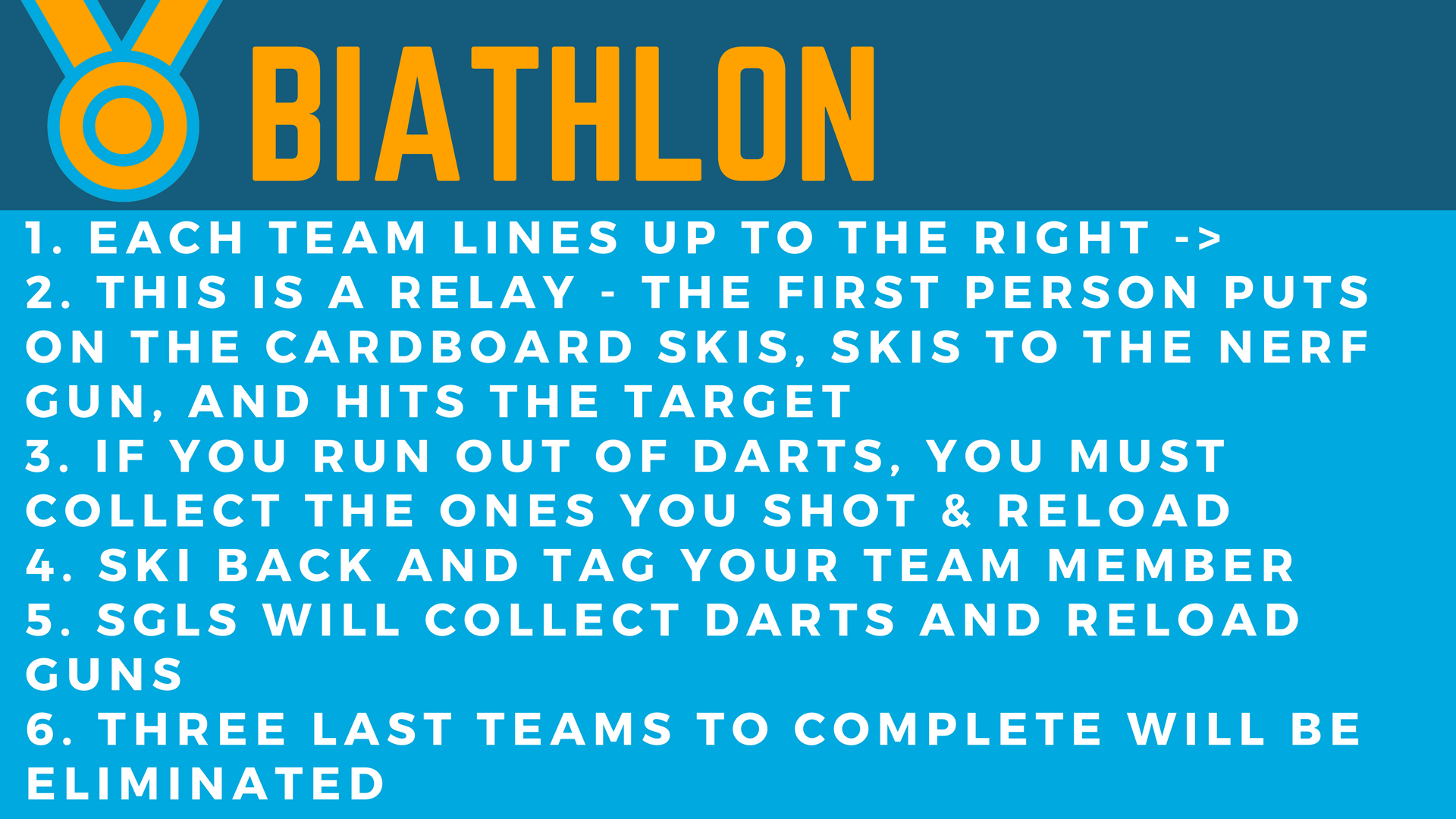
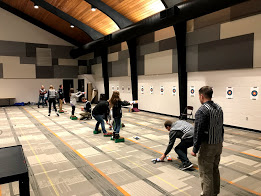
Biathlon is a game I’ve never given much thought to, until I realized it’s the most youth-ministry game ever (next to Curling!). We gave each team two shoe boxes–we had several leftover from Operation Christmas Child years ago. We placed tape at the “start line”, then placed Nerf Guns on the other side (two per team to keep the game moving quickly, so that adults had enough time to reload Nerf guns). Students did this relay-style.

3

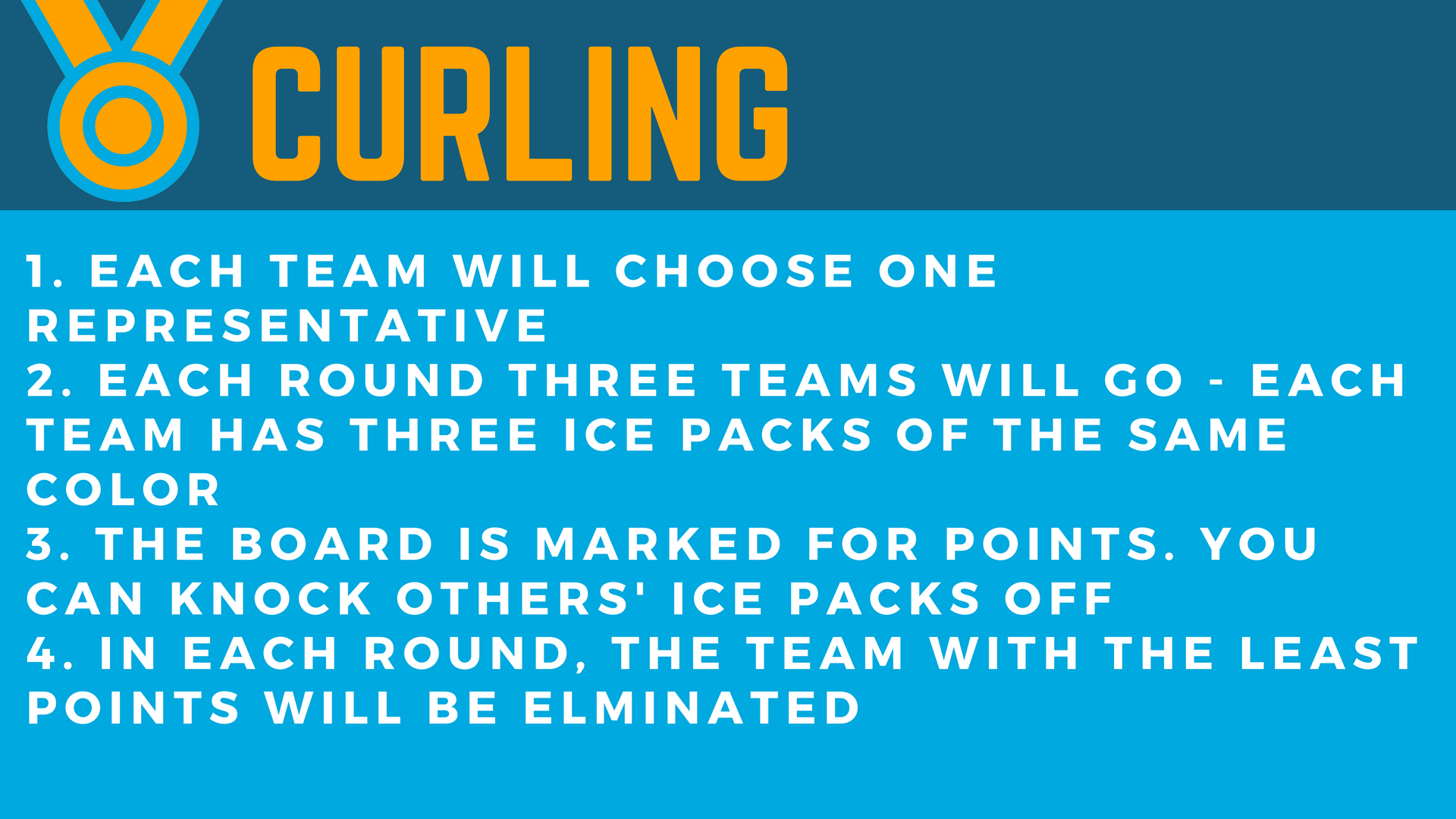
Remember those ice packs you’d get as a kid from the nurse, made from paper towels and zip-lock bags? We made ice packs by making a thick stack of paper towels, wetting them, putting them in baggies, then placing a little more water in them and some food coloring to make three different colors of ice packs. I made a score board with painter’s tape on the table (I’m mad I didn’t get a picture of this!). Three teams went at a time, and the team that has the least points at the end of round is eliminated.4

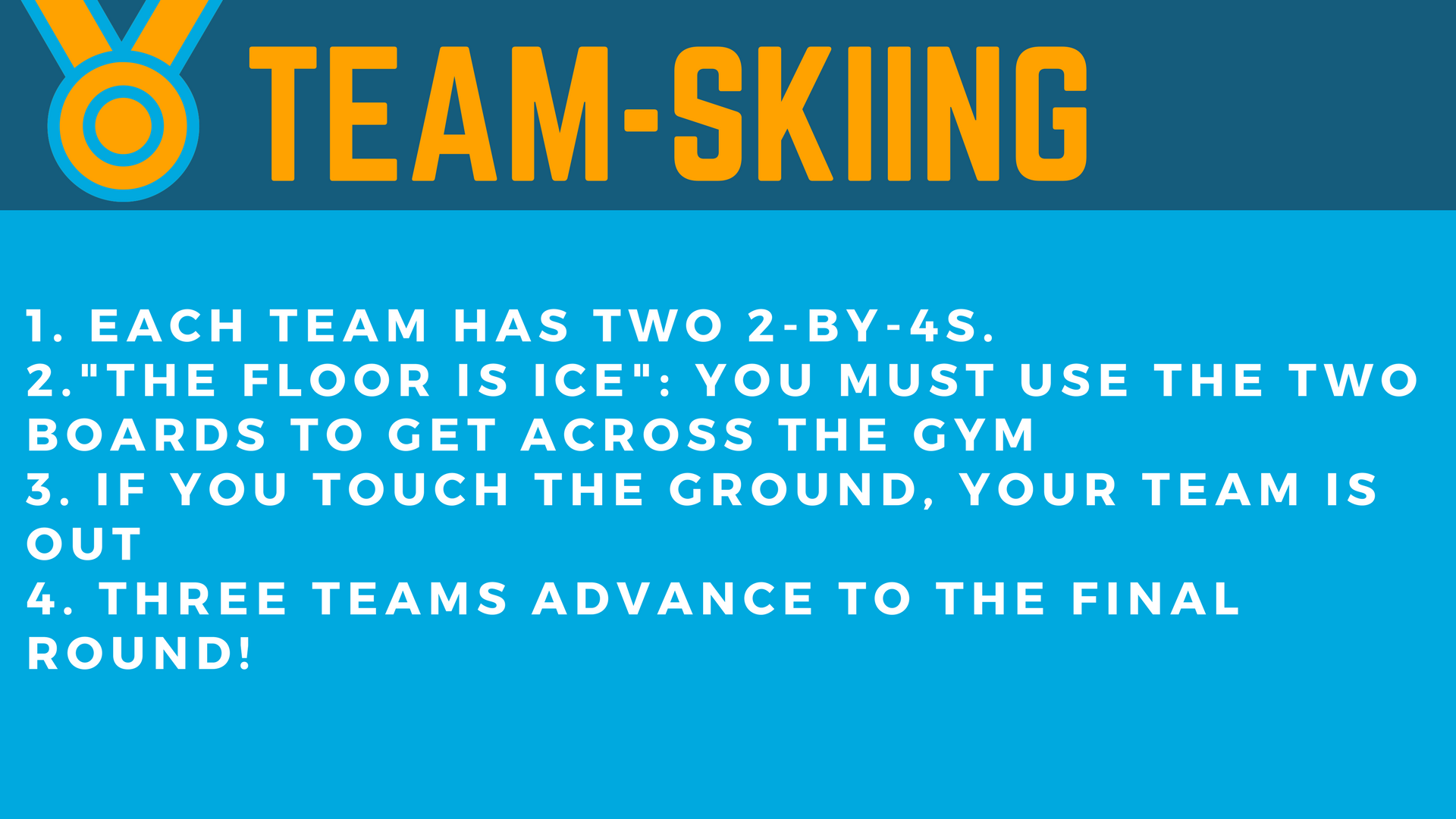
One of my favorite games of all time is a game my good friend Elisa taught me, called “Snot River.” You give the teams two two-by-fours, and they have to figure out how to get their entire team across the river without touching the floor. We gave the two-by-fours to the students and told them that however they could get across, go for it! They just had to remember that the floor is lava/snot/ice and they can’t touch it. We had a time limit, and at the end there were only three teams left, but the team that had the most people across won. We placed them in 1st, 2nd, and 3rd going into the final rounds.5

We pre-chose ten songs for the students, and our high school director even made some hilarious videos to go in the back of each of the songs. We chose:

  • Uptown Funk
  • My heart will go on
  • …Are you ready
  • Don’t Stop Believing
  • Despacito
  • Filthy
  • Thunder
  • U Can’t Touch This
  • Havana

The first place team got to choose their song first, then so on. While teams chose their songs and did their strategies, I played this workout video that I’m obsessed with to get students moving…so they didn’t get bored. Middle schoolers are always bored and demanding that I entertain them. What’s more entertaining than this?

6

The medals we gave out were pieces of candy on ribbon. Creative, right? Cheapest way to award your participants, and let’s be honest; they’ll throw anything you give them away…but they WILL eat candy.

Summer Games 2016

We did an Olympics “Invite Night” (which is our outreach-ceneterd monthly event). One of my favorite pieces of the evening was the Taco Bell Olympics games that we did up-front with students. Purchase that here–I highly recommend it! The games included:

  • Baja Blast Relay
  • Crunchwrap Curling
  • Loaded Griller Javelin Throw
  • 12-Pack Marathon

We gave students stations that represented some games you might play at the summer games:

  • basketball
  • volleyball
  • soccer
  • broom ball (like hockey, but in the summertime!)

Shout to Hebrews 12 on “running the race” as your lesson theme. You are welcome. We also had inflatable globes that students could hit during worship, and hung flags around our chapel.

20160923_211507

Winter Games 2014

My games get less clever as we throw it back further and further. This year I did Hockey and Ice Skating, and they were a hit! But we ALSO had:

Field Curling–There’s one hula hoop in the center, and each team gets three frisbees. One team member from each team takes turns throwing their frisbee. Whoever is closest wins their round. Whoever has most round wins gets the medal!

img_20140315_1813171.jpg

Medal Hunt — fill a kiddie pool with Orbeez and plastic medals. Place up to 4 people around the pool. Put one minute on the clock. The kid who collects the most medals using their feet wins! Hint: do this outside. It took us a while to clean this up from the retreat center we were at!

Sled Relay — First person in line puts the second person in line in their sled, and they race them to the other side. Second person gets out, runs the sled back, and then carries over the third person to the other side. First team to finish the relay wins!

ending thoughts…

There is so much more that I could say about how to incorporate the Olympics into student ministry. It’s such an easy win to do the games in some way each time it rolls around. For us, each year has been different: This year, on a Sunday morning; two years ago, at a special event; four years ago, as a part of a retreat weekend. It’s an awesome way to get students interacting on teams and relating a sport that should be appreciated to their own story.

I encourage you to consult Pinterest for more–there are lots more games, snack ideas, and cool ways to customize the Olympics, no matter the size group your have

Youth Group Birthday Games

games, Uncategorized, youth ministry

it's a bowling birthday party.png

My birthday fell on a Wednesday this year, and I decided to throw a birthday party for my middle school students!

I took inspiration from my dear friend Elisa, another youth worker, who at a former church shared a birthday week with her co-diretor of youth ministry. They threw a huge birthday bash for all of their students. For them, they called it “everyone’s birthday party”–so no matter when your birthday is, your celebration was that evening. For me, I marketed mine as “Heather’s Birthday Party…FOR YOU!”

I love the idea of sharing your birthday with students! I came up with some silly games. Enjoy!

Balloon Stomp

PREP: Balloon Stomp is one of the most classic youth ministry games of all time–each person has a balloon and a piece of string. They blow up the balloon, tie it to the string, and tie it to the foot (make sure that they tie it so that there is slack on the string–some of my students like to cheat and make the balloon TINY and then tie it to the ankle).

OBJECT: Students stomp on each other’s balloons. Once you’re popped, you’re out. Last balloon standing wins.

TIPS & TRICKS:

  • As the number of students dwindles down, make sure to also reduce the space.
  • One way to do this is to have everyone make a circle, hold hands, and stomp on each other’s balloons.
  • To make it chaotic, I like to call out to those who have been eliminated to get back in there and stomp on the balloons to eliminate quickly. You could even play a version where, from the beginning, when someone is eliminated they still play!

Human Piñata

OBJECT & PREP: Students are holding candy (in their pockets, on their person, etc) and a pool noodle. Students will hit each other, and if so, they give up candy.

VERSIONS:

  • Each person has a pool noodle and has candy (in their shirt, pockets, wherever). Essentially, students just go crazy and hit each other. When you get hit, you have to drop some candy. This game doesn’t really go smoothly, it’s just an excuse to hit each other and give out candy. After a certain amount of time, you yell out and everyone collects candy.
  • Each person has a pool noodle and candy. When a person is hit, they’re “out” and must drop all of their candy. At the end, you tell the last person that they get all of the candy. Then, say “just kidding” and everyone else gets in there and collects too!
  • One or a few people have a pool noodle, and a shirt that has candy taped to it (or, a bucket taped to their back with some candy in it). Students try to grab candy from the person’s clothing. If they get hit, they are out.

Extreme Pin the Tail on the Donkey Relay

PREP: Put a “Pin the Tail on the Donkey” game on the wall (we used “Pin the Like on the Emoji” from Five Below). Make enough Tails for each person–in sticker form or with tape on it. Since this is a relay, you can have on Pin-the-Tail game per team, or have them all race to one board.

OBJECT: Students spin around ten times (counting out loud), then run to the board and pin their Tail on. They then run back, tag the next person in line’s hand, and they do the same. The first team to get all their Tails pinned wins!

Cupcake Wars

VARIATIONS: You can play this as an up-front game with a large group, or you can include all students with a medium or small-sized group.

PREP: 

  • Bake or purchase enough cupcakes for each student.
  • Get some supplies to decorate the cupcakes: Frosting, icing, sprinkles, candy (Skittles, Mike & Ikes, M&Ms, Red Hots, Runts, etc.), chocolate chips, etc.
  • Place supplies in the center, put plates in each placeholder.

OBJECT: Best cupcake wins!

Top Reads of 2017

book review

I love reading. So much. Here are my five favorite books from this year:

Braving the Wilderness by Brene Brown: Braving the Wilderness is a book all about shame–something we all experience but can’t seem to put into words (or are too ashamed to–see what I did there?). I devoured this in a day, unlike her last book, which took me 10 months to read because it kept kicking my butt. I feel like this book was really influential in my journey this year.

Stand Out 2.0 by Marcus Buckingham: One of the things I’ve most enjoyed this year is taking some time to understand what my strengths are. I’ve often bought into the lie that I need to strengthen my weaknesses, but through the Strengthfinders test and now the Stand Out 2.0 test, I realize that what I need to do instead is to harness all the great things about me and find people to stand in my gaps. I feel like my sense of self-awareness is sharper than ever, and my self-confidence has really improved. PS, this book is actually really short.

Intentional Living by John C. Maxwell: I wasn’t sure about this book, since a grinning old white guy was on the cover. But I heard him speak last year at the Global Leadership Summit, and I put his book on my bedside table for 7 months before I finally picked it up and devoured it. Maxwell talks a lot about owning your story and telling it well–something that obviously interests me. He has a lot of his own personal stories in it, as well as practical activities.

The Power of Habit by Charles Duhigg: This year I really wanted to focus on better habits (I might have failed at this). I loved this book, because it was more than self-help; it talked about how habits are formed, and related it not only to our personal habits but even how companies track our habits (which I found equally fascinating and creepy). This book was great for both the self-help geek and the information geek inside of me.

Off Balance by Matthew Kelly: One of the things I’ve been struggling with is how to do ministry, which I love, while also supporting a relationship with a kind man, who I also love. HOW CAN I SPEND ALL MY TIME WITH BOTH?! The great thing this book taught me is that balance is a lie, and the more I put up boundaries, the more chaos I make for myself. So, I quit having so many boundaries, and I feel more balanced than ever. Strange. But it works.

Honorary mentions of what I meant to read but didn’t even though they’ve been on my bedside table all year because I stink but PROMISE I WILL NEXT YEAR OKAY:

  • What is the Bible? By Rob Bell
  • Out of Sorts by Sarah Bessey
  • Option B by Sheryl Sandberg & Adam Grant
  • Emotional Intelligence 2.0 by Travis Bradberry & Jean Greaves
  • Martin Luther by Eric Mextexas (it took me 2 hours to read 70 pages)

What else should I read in 2018?

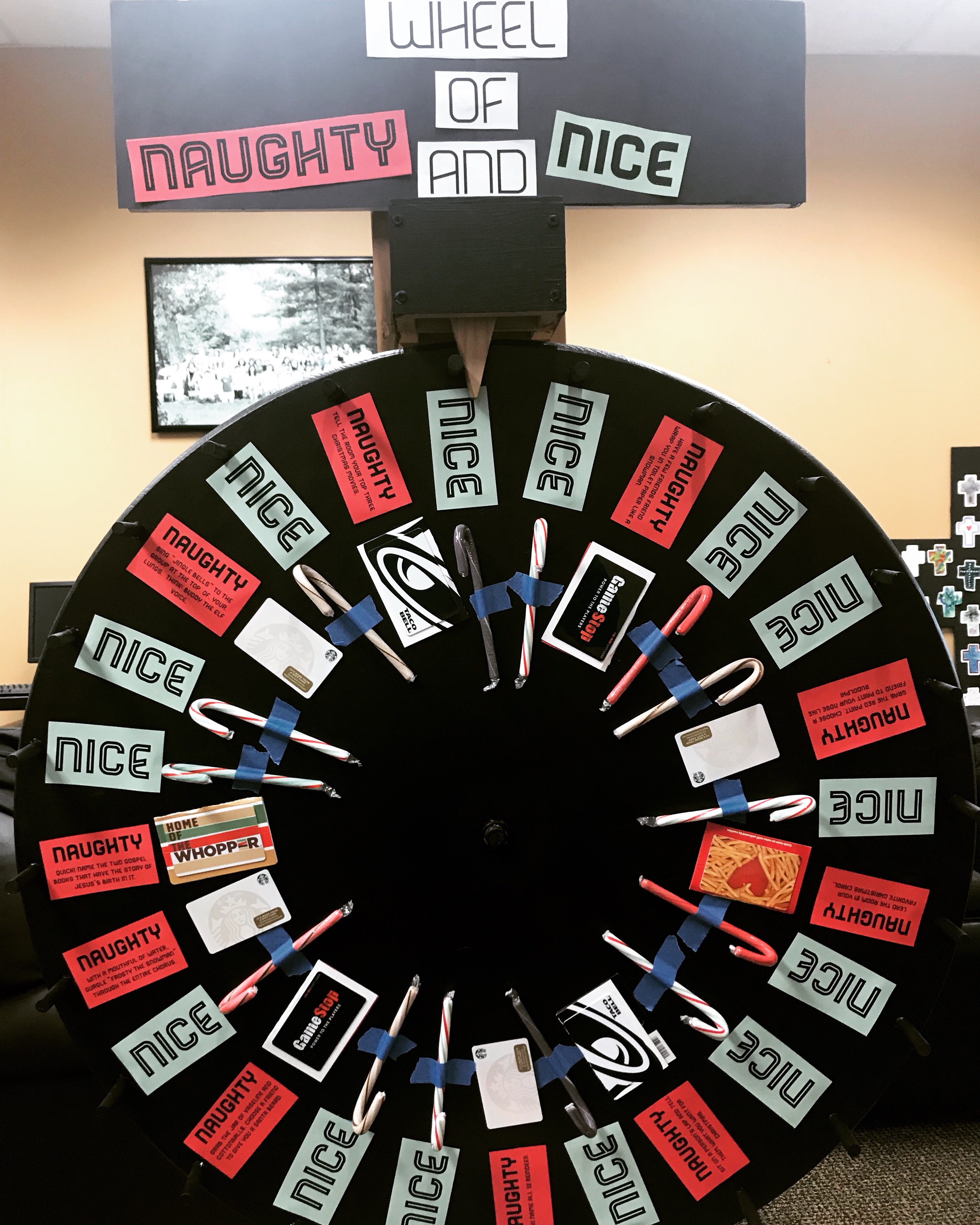
Christmas Game: Wheel of Naughty & Nice

games, Resources, youth ministry

I wanted to share my favorite Christmas game with you all-a game that I made up last year for our student ministry!

20161218_093305.jpg

The Main Idea: The Wheel of Naughty & Nice is a game that you can use with students to determine if they’ve been naughty or nice this year! If they spin “nice,” they get a candy cane. If they spin “naughty,” they have a chance to make up for their behavior and get an even better prize: a gift card. We used gift cards for Starbucks, Dairy Queen, Taco Bell, iTuness, & Steak N Shake.

Setting it up: Each “Nice” label has a candy cane underneath it, and each “Naughty” label has a challenge and then a gift card underneath. We use painter’s tape, FYI.

The “Naughty” Challenges:

  • Sing “Jingle Bells” at the top of your lungs. Think: your best Buddy the Elf voice.
  • Grab the jar of vaseline and cotton balls. Convince a friend to let you give them a Santa beard.
  • With a mouthful of water, hum “Frosty the Snowman” through the entire chorus.
  • QUICK! Name all 12 Reindeer
  • QUICK! Name the two books of the Bible that the birth of Jesus is in.
  • Sit on a person’s lap and tell them what you want for Christmas.
  • Lead the room in your favorite Christmas carol
  • Tell the room your top three Christmas movies
  • Grab the red paint. Convince a friend to let you paint their nose like Rudolph!
  • Have a few friends wrap you in toilet paper like a snowman.

Make sure that you collect all the supplies you need for the wheel and place them near your wheel for easy access! You can also do additional challenges. I have done challenges where students wrap each other like presents or decorate like Christmas trees, but that tends to take a lot of time–if an activity takes some time, and you have a large group that won’t pay attention for more than 60 seconds, have them move to the side, and keep spinning the wheel; then “check back in” with the challenge and give them their reward.

One last note: have a plan for if a student spins the wheel on an empty spot previously chosen by another. Either have an extra candy cane for them, or let them spin again.

Hope y’all enjoy! This was a hit with our students last year, and we are making another for this year.

update: here’s our picture for this year! The only issue was that we didn’t put it BETWEEN the prongs, so students kept spinning and choosing two. Don’t make our mistake! 😂

A story about an 8th grade boy

junior high ministry, lessons, youth ministry

In my last post I talked about sharing stories of hope. So here’s a nice one for you–

In our church we teach Confirmation in 7th grade (which, for my evangelical friends: Confirmation is a “coming of age” process where students affirm the vows made at their baptism by their parents to raise them in faith, and then pledge to own their faith as their own).  One of the crazy things about Confirmation is that people come out of the woods for the process: while a class could average 25 in 6th grade, it can average 45 in 7th grade. It’s kind of insane. And one of the big problems with Confirmation in our church–and others–is that after Confirmation, that number typically goes down dramatically–to 15 students weekly.

Lots of smart minds have put their heads together trying to figure out why there’s such a big drop-off after Confirmation, but no one really has tons of answers. And that’s sad, because I love my church and think it’s exactly what a teenager needs as they go through puberty and get a car and question their entire existence before they go off to college. So, I got creative and tried to figure out: How can we keep kids after Confirmation? But there was another question: What do students need after Confirmation? And since we do Confirmation in 7th grade, we ask: What doe an 8th grader need? 

We identified that an appropriate response to Confirming your faith would be to discover your Spiritual Gifts. This makes perfect sense for the 8th grade year, since ending middle school and entering high school brings about several questions of identity: Who am I? What am I good at? What do I have to offer the world?

Of course, there are no year-long courses on Spiritual Gifts (and especially not for students). And my colleagues thought I’d be crazy to talk about this for an entire year with middle schoolers. Will they care? Are they going to get bored? Shouldn’t we talk about stuff they want to talk about? 

What we realized was: this is kinda perfect. But we also decided to make sure that an 8th grader has a way of practicing their spiritual gifts as they are learning about them. So, I did several steps:

  • We used the Spiritual Gifts assessment and resources by LeaderTreks
  • I split the 15 gifts into 5 categories
  • Each of the 5 categories is a “unit”
  • At the end of the unit, we practice the gift in a hands-on way
  • (yes, I’ll go into this more into detail later. Shoot, I might even market this jank or give it away for free)

This month we did our unit on “Teachers” and focused on the gifts of Teaching, Evangelizing, and Mentoring/Pastoring. For the end of the unit, the 8th graders took over The Modge, our program for 5th & 6th graders. I decided to ask an 8th grade student to teach that day, and then have their peers lead Small Groups.

Who to ask? The class clown, obviously. Last year in 7th grade, Bob (not his name) would purposely troll the class. He was the kid that would shout things out, that would put silly questions in our “Ask Anything” jar, and who would be generally obnoxious. One leader even asked me if he could not be in his small group, because he can overwhelm things in a group setting.

But y’all. I believe in chaos. And when I got Bob’s gifts assessment back at the beginning of the year and saw Leadership, Speaking Out (prophecy), and Pioneering (apostleship). I squealed. I knew it. knew this kid was a leader.

And last month as I was teaching the lesson Evangelism, Bob shouted out “Heather, you want me to teach today?” And I laughed. And then I thought, “No, this boy should be teaching something.”

So I emailed his parents. And got his cell phone number. And talked to his dad. And told my leaders. And everyone thought it was equally crazy and equally possible that this could be the most brilliant thing to happen to our ministry. Maybe this could change things. Maybe this could solve our concerns about retention. Maybe this could just work.

And after meeting with him twice, high-fiving him 57 times, and handing over the stage? It did. It was amazing. At one point I took my eyes off of him to look around the room at all my leaders–who were all in awe with their mouths agape and grinning from ear-to-ear.

And when I asked his peers afterwards what they thought–they were impressed that their friend had the bravery to stand in a room full of almost 80 people.

Here’s another thing I love about this story: Bob’s lesson was on the shepherds at Jesus’s birth. The bottom line for the lesson was that God can use anybody to share his message with others. That shepherds had a lowly job, but they were visited by angels and given the only invitation to the greatest thing that has ever happened to our world–and then given the job to go share with with others.

Catch that? I didn’t even realize it until he was sharing his “underdog story” that we crafted together: God can use anybody to share his message with others. Even an 8th grade boy.

As for answering what to do after Confirmation, I’m not sure I have the magical answer. But what I walked away from Sunday thinking was, “I want to do this again.” I want to empower another student to lead. I want to see another student proclaim God’s promises from the stage. I want to see another group of students support their friend (even if they initially doubted him). I want to see another parent surprised at their kid’s potential. I want to see more Small Group Leaders rewarded for their investments pastoring these kids.

I want to see more. I need to see more. I crave more now. Because kids like Bob will solve all our problems but, more, they will readjust our hope for the church to be more about transforming lives and less about numbers.

Introducing: Letters to the Church

curriculum, Resources, youth ministry, Youth Specialties

Hi all! A few years ago, as I was writing the New Testament year for our middle school ministry’s rotation, I realized that there were no series out there on the Epistles. None. Nada. There are stories on Galatians, or Corinthians, or Philippians, but none that highlight each book and some of their core teachings.

So I wrote my own.

Introducing: Letters to the Church, on Youth Specialties! You can purchase a 6-week series for just $17. This is my first curriculum with my very own name on it (I wrote for YM360’s The Thread a few years back). I’m pretty proud of it, and I hope you find it to be original and helpful!

When Students Ask About Trump

america, Evangelicalism, lessons, politics, social activism

The only thing Trump and I have in common is that we both cannot control our facial expressions.

One of my favorite parts of our 7th Grade Confirmation is the “Questions Jar” that students can put questions about anything in. It says on it “Write ANY question you have down on a piece of paper, and Heather may answer it on a Sunday morning! It can be about God, Confirmation, family, friends, a weird Bible verse, sports, the meaning of life, food, whatever you want! Think of this as a human Google machine.”

Students ask a variety of questions, and I kind of love it. I love answering their hardest questions on-the-spot (even if it makes me sweat and panic a little). We host three panels each Confirmation year and commit to answering all the questions.

At our last panel, I pulled out the question, “How does God feel about Donald Trump? What do you think about him?”

I handed it to my boss and said, “Do you want this one? Or do you want me to handle it?” I didn’t know what I wanted in that moment, whether I wanted to go for it or defer, but he told me I had it.

I read it out loud, took a deep breath as everyone giggled, and said something like this:

There’s a story in the Bible that goes something like this: A rich man came to Jesus and asked him, “What must I do to live eternally?” Jesus told him, “You must sell all your possessions and give them to the poor.” The rich man walked away from Jesus, and Jesus told the crowd “It is easier for a camel to pass through the eye of a needle than it is for a rich man to enter the kingdom of God.” (Matthew 19)

What does this have to do with politics?

Well, Donald Trump has a lot of money, like many other politicians. Many view running for president as a way to get more power and more possessions. And when you are fighting for power, often times you are forgetting the least-of-these that Jesus talked about. When you’re focused on getting more, you forget the people who have less.

We know that our purpose on earth is to take care of one another. Many politicians have lost sight of this. So what do I think that God thinks of Donald Trump? I think that God is very disappointed with him, because he could be using his money and power to help people. But I think God is disappointed with most politicians, because they all seem to be doing the same thing–taking advantage of others in order to gain more for themselves.

But the thing is–God still loves them a crazy amount. It can be hard to see at times, but they were also made in God’s image and God loves them very much. So as much as some politicians disappoint God and disgust us, they still deserve a certain degree of respect and honor. They are still our leaders, even if we don’t like them.

But let’s not forget that Jesus fought to change the political systems in place that oppressed people through his own actions, and that’s what infuriated people and got him killed.

So, don’t hate Trump or other politicians that aren’t taking care of the people. Be part of the solution by doing the things that Jesus asked of us, even if our government and president won’t.

I think that was about the best I could do on the spot. But the more I think about it, I think that the Holy Spirit guided what could be a really messy conversation (Trump literally makes me vomit and cry) into a conversation about our role in the world. We can’t rely on the president to fix our problems.

On a personal note, today in the primaries I voted for the one person in this crazy circus who I think resembles Jesus. But even if they were to make office, it doesn’t take away from my role on earth to take care of the least-0f-these.

No president will ever “trump” our role to take care of one another.

Statement of Faith & Doubt

Confirmation, lessons, Theology

Faith is the confidence that what we hope for will actually happen; it gives us assurance about things we cannot see.
Hebrews 11:1

What does it mean to have faith? Growing up, this verse in Hebrews comforted me to have confidence even when I’m not sure of what I’m even confident about.

Working with teenagers means that you are working with doubt, and most teenagers feel like their doubt has no place in faith.  The church I grew up in told me that my doubts were normal, but that I also needed to “give my doubts to God.”

That statement basically told me, “Doubts are normal, but good Christians don’t have them.”

But as I read that verse in Hebrews, I’m comforted. The author says that faith is (1) Confidence that what we hope for will actually happen and (2) Assurance about the things we cannot see. Other versions say that we are convicted.

Put together, faith is simply when the acknowledgment of doubt convinces us to press on.

This year I added to our Confirmation experience for students to write a Statement of Faith. We had talked about doubts back in October in my favorite lesson of the year. As I studied Statements of Faith, I encountered this article by Fuller Youth Institute:

Another church from one of our Sticky Faith Cohorts is working hard to create space for doubt in the midst of its Confirmation program. At the conclusion of the six-month process, most students write a statement of faith. Last year one student felt safe enough to write a “Statement of Doubt” instead. This allowed her to share openly with the community that her own journey of faith wasn’t yet at the place of trusting Christ. Several months later, she came to the point where she had wrestled through her doubts and decided to be baptized as an expression of her newfound trust. Alongside her were several adults who had supported her, prayed for her, and walked with her through her valley of doubt to the other side of faith.

I talked about the possibility of doing this project with our Family Ministries Pastor, and I shared my doubts with him: that if I talked about doubts with our students, they would only come to realization that they doubt a whole hell of a lot (literally. hell is a huge doubt for all of us).

But he encouraged me to give this a go.

I’m so thankful to work at a church that says both “We believe” and I believe,” meaning that we have a faith that is both universal and connected by tradition, but also that is very personal and varies from our neighbors.

I knew that I wanted to give students space to write their doubts, so I launched the “Statement of Faith & Doubt” project. Here were the steps:

Introducing the Concept

On the day of Confirmation that I introduced the project, I had students take different creeds that I printed out for them, and in groups underline the statements they agree with, and cross out the statements they weren’t so sure about. We had them write a few of the statements on a large piece of butcher paper I had on the wall.

I shared about how when I was in high school, I would always skip saying the part of the Apostle’s Creed where it says Jesus “ascended to the dead.” I thought it was creepy, and I didn’t like it. So I didn’t say it. I shared about how sometimes we don’t like the things in the Bible, or we share different beliefs from others–and that’s okay.

Also–here’s the video of me teaching that lesson.

The Project Itself

Students would, on their own, look in the back of the UMC hymnal at the section where it says “Affirmations of Faith.” There is listed a handful of creeds and statements of faith. They would write down 8 statements they agreed with, and 2 statements they didn’t.

Students would bring these Statements of Faith & Doubt to their small groups on a designated Sunday to discuss.

We sent this home with Confirmands to give to their parents with ways for Parents to plug in. Parents and mentors had questions to discuss with students about these projects on their own time.

Outcome

Small groups shared these statements of faith and talked about how doubt plays a crucial role in faith. I gave them the following small group questions:

  • Was it difficult to choose things you believed in? What about the things you doubted?
  • What’s the difference between faith and doubt?
  • Read Hebrews 1:1-3 together. How does doubt have a place in our faith?
  • Have confirmands look at their statements. Do you think that there are some things that you aren’t allowed to doubt? Like, can you doubt the virgin birth and still be a Christian?

There were a lot of commonalities in their statements–every single person doubts or dislikes the judgement of sinners. But there were also some unique statements. Here are some of those. Some are funny, others remind me of the life stage middle schoolers are in, and some convict me of what I believe now.

Statements of Faith…

  • Jesus was born of the virgin Mary. (I don’t understand why they underlined virgin, but I found it amusing
  • Jesus was is God’s son.
  • We commit ourselves to the right of…and people with disabilities. (Loved this, since her older brother has a disability)
  • Nothing will be able to separate us from the love of God.
  • For our sake he was crucified under Pontius Pilate.
  • We are not alone. (Yes, middle schooler.)
  • Great indeed is the mystery of the Gospel. Amen.

Statements of Doubt (Don’t believe / Not sure about / Don’t understand / Confusing)…

  • And in Jesus Christ his only Son. “I have always been taught that we are God’s children and this sentence contradicts that. It says that he only has one son instead of us being his children.”
  • He was crucified under Pontius Pilate. “What is under Pontius Pilate?” “What is a Pontius Pilate?” “When reading John, I found that Pilate didn’t care, it was the people that crucified him.”  (That last one made my HEART. MELT.)
  • He shall come to join the living and the dead
  • We look for the resurrection of the dead
  • We believe for the forgiveness of sins
  • Who shall separate us from the love of Christ? Shall tribulation or distress, or persecution or famine…?
  • …where we are all brothers and sisters
  • Proclaimed among the nations
  • One Catholic church
  • You have to be baptized to go to heaven
  • That he was put in a grave. “Wrong! He was buried in a tomb.”
  • That God was conceived by the Holy Spirit. “What does conceived mean?”

Last, I had two people who ignored the Creeds and made their own Statement of Faith and Doubt. This one was precious:

I believe in God,
that the thoughts in my head are sent from him
I believe he creates feelings of love
but for others, feelings of hate
I believe he puts pain onto others
but he usually spreads love
I believe that he first expected we’d sin
but not this much
I know what he expects,
and that he can only take sin in reasonable doses
I know he’s holy
I know he does love
but I believe,
after so many sins – We get a bad memory in life
He is trying to make us learn,
We just have to accept it

This project is risky–when we talk about doubt, we get vulnerable. We admit that we don’t know everything. We have to say out loud things that we don’t think we are allowed to say.

But it is rewarding–because if we can’t admit out loud our doubts to one another, then we’ll never be able to face them on our own. I noticed on a few papers that as small groups shared their doubts with one another, a few students crossed theirs out because they reconciled them just by talking about them out loud.

And that’s what it’s all about, really.

Describing Ash Wednesday

christianity, lent, Theology

I didn’t know what Ash Wednesday was until 2014, when I was in my first Lenten season at my United Methodist church. I may not have even gone to the service, except I was looking for community that evening and being introduced to a small group for the first time.

Ash Wednesday is now one of my favorite traditions. There’s something about a pastor marking a cross on your forehead while looking into your eyes and saying “Repent and believe the Gospel” that shakes you in your winter boots.

I didn’t understand what it was when I first received the ashes, and if I were to be honest, I don’t think I’ll ever understand the eternal significance of the service. Every time I try, I get blown away.

And since I couldn’t explain it well if I tried, here are my three favorite articles about Ash Wednesday.

Why Ashes? Connecting to who we are and who we can be – The United Methodist Church

When we participate in the service of ashes, we confront our sin. We recognize our inability to live up to all God has created us to be, and our need to be forgiven. No matter how often we go to church, how far we have come in our spiritual journeys, how accomplished we may feel, each of us has sinned and fallen short of the glory of God (Romans 3:23).

While this may sound fatalistic, it is not the end of the story. Lent leads to Easter, the day we celebrate that though our bodies are temporary and our lives are flawed, a day of resurrection will come when we will live in the presence of God forever.

One Wednesday every year we go to church remembering who we are, and hopeful of who we can be.

A little reading for Fat Tuesday/Ash Wednesday (from Accidental Saints) – Nadia Bolz-Weber

Here’s my image of Ash Wednesday: If our lives were a long piece of fabric with our baptism on one end and our funeral on another, and we don’t know the distance between the two, then Ash Wednesday is a time when that fabric is pinched in the middle and the ends are held up so that our baptism in the past and our funeral in the future meet. The water and words from our baptism plus the earth and words from our funerals have come from the past and future to meet us in the present. And in that meeting we are reminded of the promises of God: That we are God’s, that there is no sin, no darkness, and yes, no grave that God will not come to find us in and love us back to life. That where two or more are gathered, Christ is with us. These promises outlast our earthly bodies and the limits of time.

Ash (from Searching for Sunday) – Rachel Held-Evans

Once a year, on a Wednesday, we mix ashes with oil. We light candles and confess to one another and to God that we have sinned by what we have done and what we have left undone.  We tell the truth. Then we smear the ashes on our foreheads and together acknowledge the single reality upon which every  Catholic and Protestant, believer and atheist, scientist and mystic can agree: “Remember that you are dust and to dust and to dust you will return.” It’s the only thing we know for sure: we will die.

Ashes to ashes, dust to dust.

But a long time ago, a promise was made. A prophet called  Isaiah said a messenger would come to proclaim good news to the poor and brokenhearted, “to bestow on them a crown of beauty instead of ashes, the oil of joy instead of mourning, and a garment of praise instead of a spirit of despair.” Those who once repented in dust and ashes “will be called oaks of righteousness, a planting of the Lord for the display of his splendor” (Isaiah 61:3).

We could not become like God, so God became like us.  God showed us how to heal instead of kill, how to mend instead of destroy, how to love instead of hate, how to live instead of long for more. When we nailed God to a tree, God forgave. And when we buried God in the ground, God got up.