16 Choose-Your-Own-Adventure Service Projects

Ministry, Resources, Uncategorized, youth ministry

Just one week before our youth mission trip to St. Louis—and right before a major holiday—our only scheduled service project completely fell through. With a group of teens ready to serve and no time to secure new partners, I had a choice: panic… or pivot.

So instead of “crashing out” (as the kids say), I reimagined the entire structure of our service day.

And while most of the projects weren’t uniquely tied to St. Louis, that almost made them more magical. The youth kept asking, “Can we do this at home too?”—which, of course, was the real win.

To add: some of these are… unique. Because we had originally planned to do a VBS, I had some crafts such as Wreaths and Flower Pots that I was wondering if I could repurpose a little for service projects. But I think that was part of our magic! Many of these were also inspired from my community at Women in Youth Ministry. Need some creative last-minute ideas? These women will help!

I put the service projects on cards and laid them out on a table. Each project had a clear summary, budget, supply list, scripture verse, and a reflection question—so they were ready to completely own it.

I read the projects to the group all at once, let them talk about it, and when they were ready they came up and chose a card to do the next day. They had a half hour to plan during our evening gathering time, then the next morning had three hours to execute. I put the cash in a pencil pouch, handed it over to a youth in charge, and told them to tell our group where to go. They had full autonomy and did a phenomenal job!
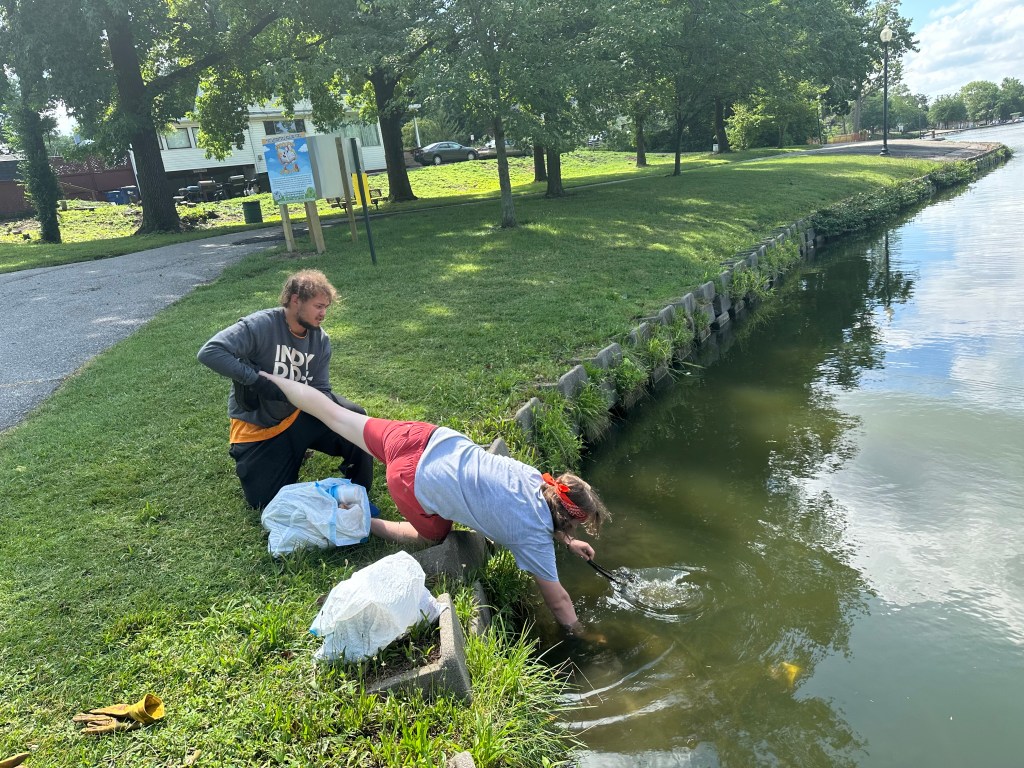
Park Cleanup

Summary: Help care for God’s creation by cleaning up litter and beautifying a local park.

Budget Guide: Low ($0–$20 for gloves, trash bags, optional snacks)

Supplies Needed: Trash bags, gloves, hand sanitizer, optional sidewalk chalk

Spiritual Goal / Verse: Genesis 2:15 – ‘The Lord God took the man and put him in the Garden of Eden to work it and take care of it.’

Reflection Question: What does it mean to take responsibility for a space we don’t own?

Little Libraries / Little Food Pantries

Summary: Stock and decorate neighborhood mini-libraries and food pantries with books, canned goods, and kind notes.

Budget Guide: $25–$100 for books, food staples, and decorating supplies

Supplies Needed: Books, canned goods, markers, notes, stickers

Spiritual Goal / Verse: Matthew 25:35 – ‘For I was hungry and you gave me something to eat.’

Reflection Question: How does sharing anonymously still help us feel connected?

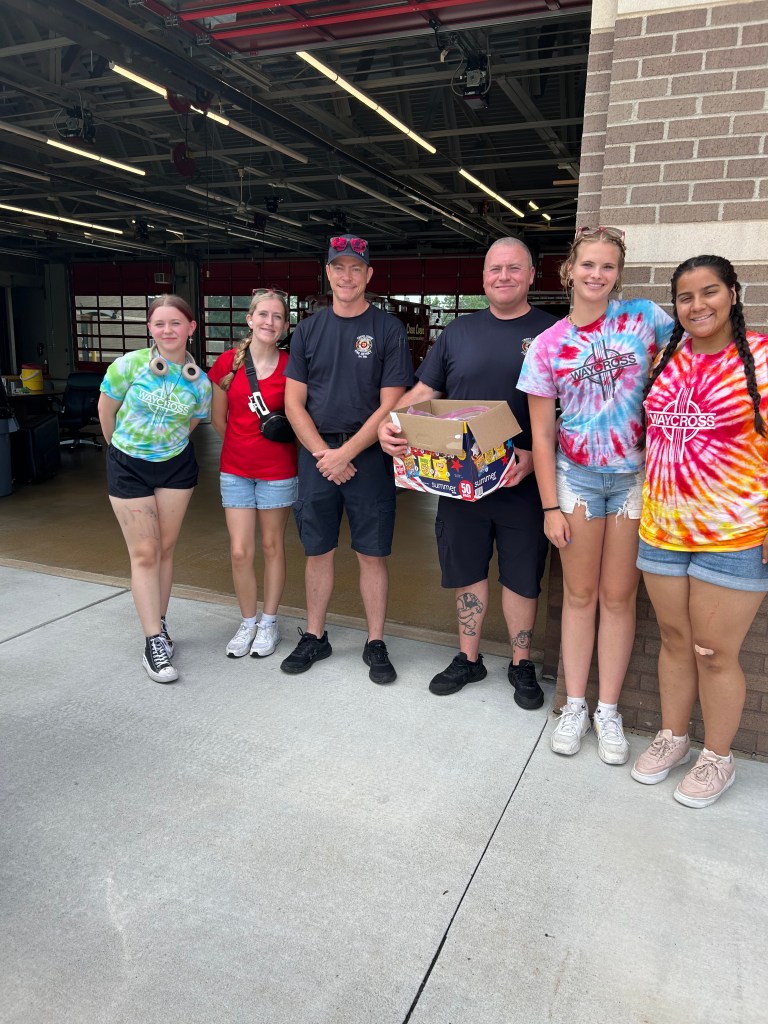
Cards & Treats for Local Police, Fire Stations, Emergency Room Workers, Etc.

Summary: Show gratitude to local first responders with handwritten cards and treats.

Budget Guide: $25–$75 for treats and card supplies

Supplies Needed: Thank-you cards, markers, store-bought snacks or baked goods

Spiritual Goal / Verse: 1 Thessalonians 5:11 – ‘Encourage one another and build each other up.’

Reflection Question: Why is it important to acknowledge people who serve in hard jobs?
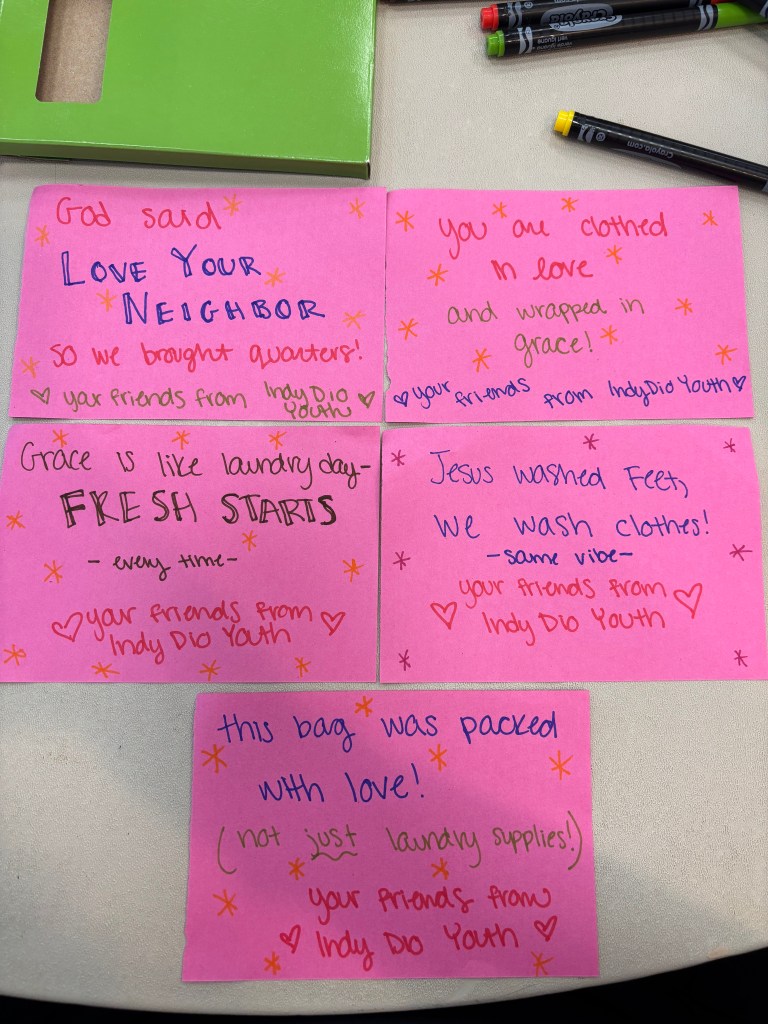
Laundry Love

Summary: Leave quarters and detergent at laundromats for neighbors doing laundry.

Budget Guide: $25–$100 in quarters and supplies

Supplies Needed: Quarters, detergent pods, ziplock bags, tape, printed notes

Spiritual Goal / Verse: Galatians 6:2 – ‘Carry each other’s burdens, and in this way you will fulfill the law of Christ.’

Reflection Question: How does meeting a basic need reflect God’s love?

Hygiene Kits for Shelters

Summary: Assemble and donate hygiene kits for people experiencing homelessness.

Budget Guide: $50–$100 for bulk hygiene supplies

Supplies Needed: Toothbrushes, toothpaste, wipes, soap, socks, ziplock bags. You could also make menstrual supplies kits (tampons, pads, wipes, even reusable cups/discs).

Spiritual Goal / Verse: Proverbs 19:17 – ‘Whoever is kind to the poor lends to the Lord.’

Reflection Question: Why does dignity matter when helping others?

Water + Snack Giveaway

Summary: Hand out water bottles and snacks at parks or bus stops with affirming notes.

Budget Guide: $25–$100 for snacks and bottled water

Supplies Needed: Water bottles, snacks, handwritten notes or stickers

Spiritual Goal / Verse:: Mark 9:41 – ‘Anyone who gives you a cup of water in my name… will certainly not lose their reward.’

Reflection Question: What does it feel like to give without expecting anything in return?
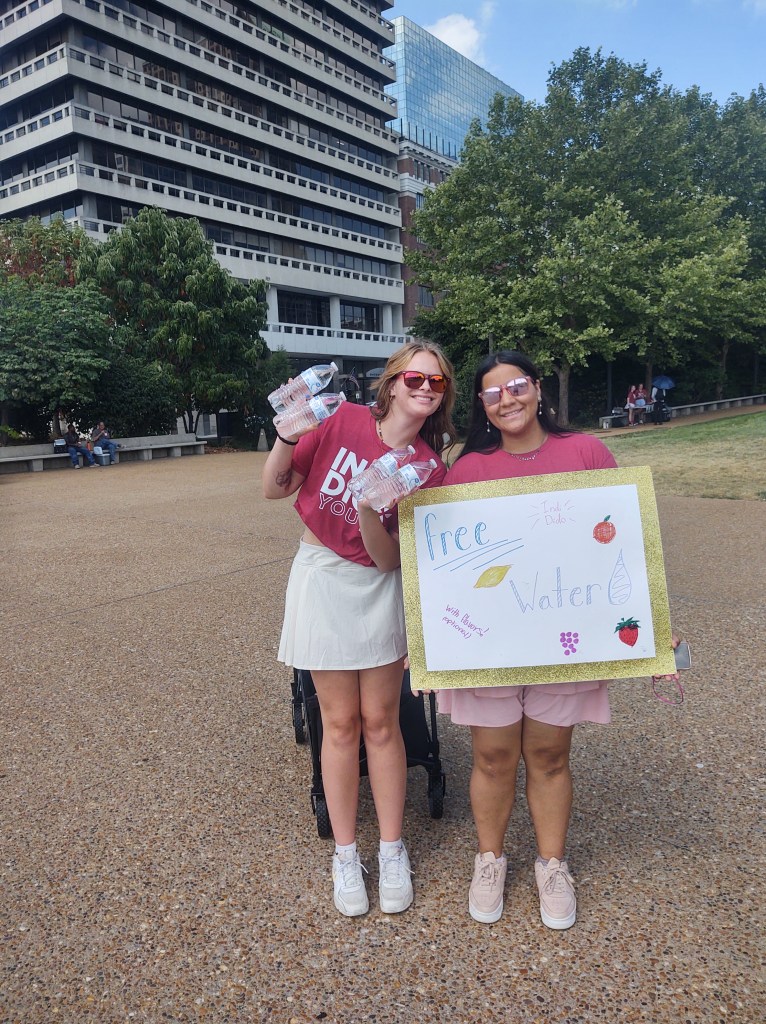
Lemonade & Listening

Summary: Offer free lemonade and kind conversation in a local park or busy street corner.

Budget Guide: $20–$40 for lemonade supplies and signage

Supplies Needed: Cooler, cups, lemonade mix, poster board, markers, chairs

Spiritual Goal / Verse: Hebrews 13:2 – ‘Do not forget to show hospitality to strangers.’

Reflection Question: What can we learn when we stop to really listen to others?

“Ray of Sunshine” Baskets for the Homebound

Summary:  Create cheerful baskets filled with all yellow items and handmade cards to brighten the day of members of the church who are currently homebound. Coordinate with (insert church’s name) contact list.

Budget Guide: $100 total

Supplies Needed: Yellow baskets/bags, yellow items (lemon drops, socks, journals, teas, candles, pens, etc), list from the church, handmade cards, tags for bags

Spiritual Goal / Verse: Philippians 1:3–5 – “I thank my God every time I remember you. In all my prayers for all of you, I always pray with joy.”

Reflection Question: How can we reflect God’s light to those who may feel forgotten or isolated?

Unhoused Showers Ministry

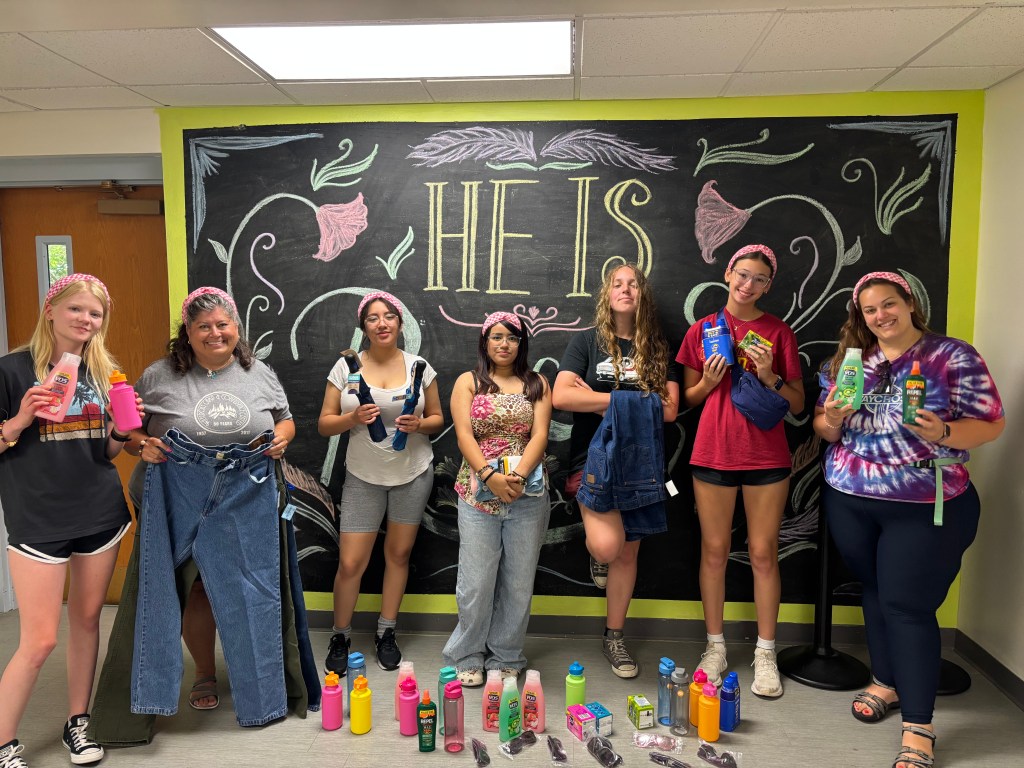
Summary: Collect items for a local church or shelter’s Showers Ministry, which helps people who are unhoused.

Budget Guide: $100

Supplies Needed: Shower supplies – or check with the ministry’s list of needed supplies

Spiritual Goal / Verse:Isaiah 58:7 (NRSV) – “Is it not to share your bread with the hungry, and bring the homeless poor into your house; when you see the naked, to cover them, and not to hide yourself from your own kin?”

Reflection Question: What does it mean to see someone experiencing homelessness not as a stranger, but as kin?

Our group chose to donate these items to St. Charles UMC’s Shower Ministry, but any shelter or street outreach program would be blessed by this.
Diaper Blessings

Summary: Shop for diapers in a variety of sizes and donate them to a local diaper bank or shelter that serves families in need. Create handwritten cards or notes of blessing to include with the donation—something simple to encourage and uplift parents or caregivers.

Budget Guide: $100 total

Supplies Needed: Diapers, card-making supplies

Spiritual Goal / Verse: Psalm 127:3 – “Children are a heritage from the Lord, offspring a reward from him.”

Reflection Question: What does it mean to support someone you’ll never meet? How does this kind of giving reflect God’s trust in us to care for each other?
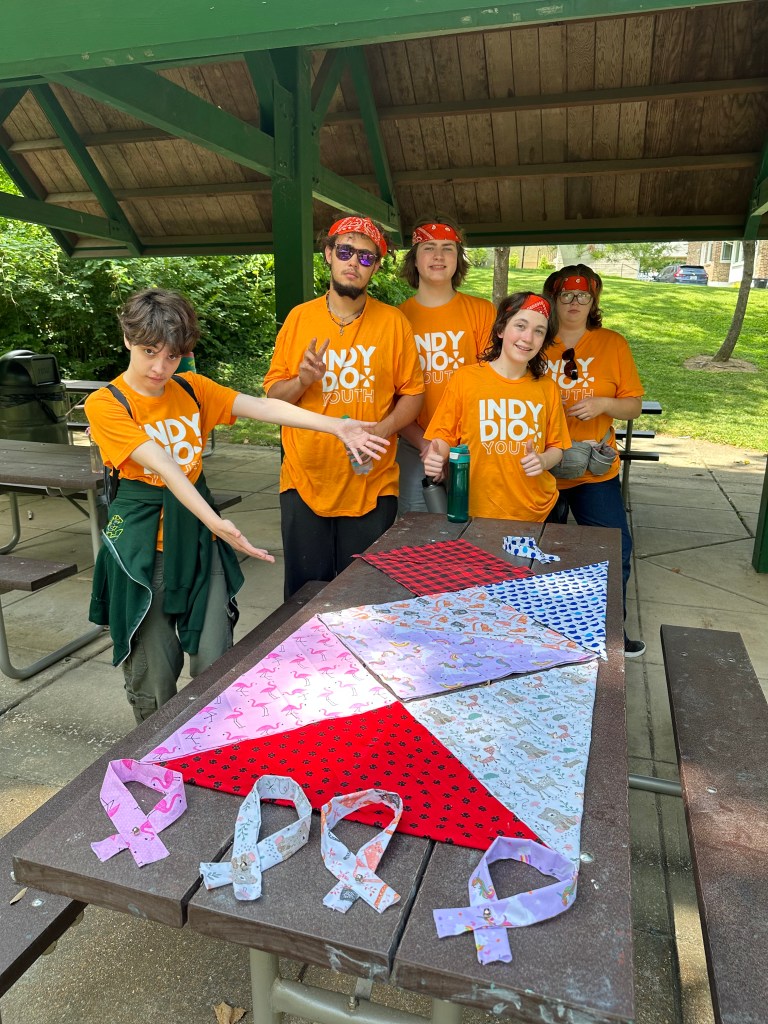
Bandanas for Pet Shelters

Summary: Create cheerful pet bandanas for animals in shelters to wear during adoption events. These small accessories can make pets more approachable and increase their chances of finding a forever home.

Budget Guide: $25–$75 for fabric, pinking shears, and optional fabric markers

Supplies Needed: Fabric from a craft stores, sharp scissors or pinking shears

Spiritual Goal / Verse: Proverbs 12:10 – “The righteous care for the needs of their animals.”

Reflection Question: How can simple acts of kindness toward animals reflect God’s love for all creation?

Dollar Tree Dinners

Summary: Create shelf-stable, low-cost meal kits. Each kit should fit in a gallon-sized Ziploc bag and include a simple recipe card. Drop off at a local food pantry to help people prepare a full meal with ease. Dollar Tree Dinners on TikTok has a examples.

Budget Guide: $100 total

Supplies Needed: Gallon-sized Ziploc bags, shelf-stable meal ingredients, index cards, markers/pens

Spiritual Goal / Verse: James 2:15–16 – “If a brother or sister is poorly clothed and lacking in daily food, and one of you says to them, ‘Go in peace, be warmed and filled,’ without giving them the things needed for the body, what good is that?”

Reflection Question: How can meeting someone’s basic needs also help them feel seen, valued, and loved?

Food Pantry Restock

Summary: Many food pantries are facing shortages and budget cuts. This project invites you to research a local pantry, discover their most-needed items, and use your group’s budget to shop thoughtfully. Your donations will help restock their shelves and ensure families have access to what they need.

Budget Guide: $100 total

Supplies Needed:

Spiritual Goal / Verse: Matthew 25:35 – “For I was hungry and you gave me something to eat.”

Reflection Question: How does feeding someone—whether you know them or not—connect us more deeply to God’s love?

Because St. Louis experienced a tornado, we did a collective Tornado Relief drive. We dropped bags off on Monday and got them on Thursday – taking two days of our week!

Joy Wreaths for Nursing Homes

Summary: Research local food pantries and look up what they are in most need of right now. Many food pantries have lost funding.

Budget Guide: $100 total

Supplies Needed: Wreaths (we have cardboard wreaths), items from a craft store/dollar tree. Use cord/string for hanging.

Spiritual Goal / Verse: Romans 15:13 – “May the God of hope fill you with all joy and peace in believing, so that you may abound in hope by the power of the Holy Spirit.”

Reflection Question: How can a simple, handmade gift become a reminder of God’s joy and presence in someone’s life?

Flower Pots for First Responders, Nursing Homes, etc.

Summary: Decorate flower pots and plant seeds as a symbol of gratitude, growth, and care. Pair each pot with a handwritten thank-you card and deliver to people who serve or may feel forgotten—such as first responders, healthcare workers, nursing home residents, or long-time church members.

Budget Guide: N/A – items in stock!

Supplies Needed: Thank-you cards, markers, flower pots, peats, seeds, paint markers

Spiritual Goal / Verse:  1 Corinthians 3:6–7 – “I planted, Apollos watered, but God gave the growth. So neither the one who plants nor the one who waters is anything, but only God who gives the growth.”

Reflection Question: How can small, thoughtful actions plant seeds of gratitude and hope in someone else’s life?

Create Your Own!

Summary: Come up with your own service project! Stay within budget and submit your plan to a leader.

Budget Guide: Up to $100

Supplies Needed: Whatever your group dreams up!

Spiritual Goal / Verse: Ephesians 2:10 – ‘For we are God’s handiwork, created in Christ Jesus to do good works.’

Reflection Question: What needs are you noticing that others might miss?


Click here to download the simple cards I made in Microsoft Word!

Embracing Unity: Lessons from the Converge Conference

Ministry, youth ministry

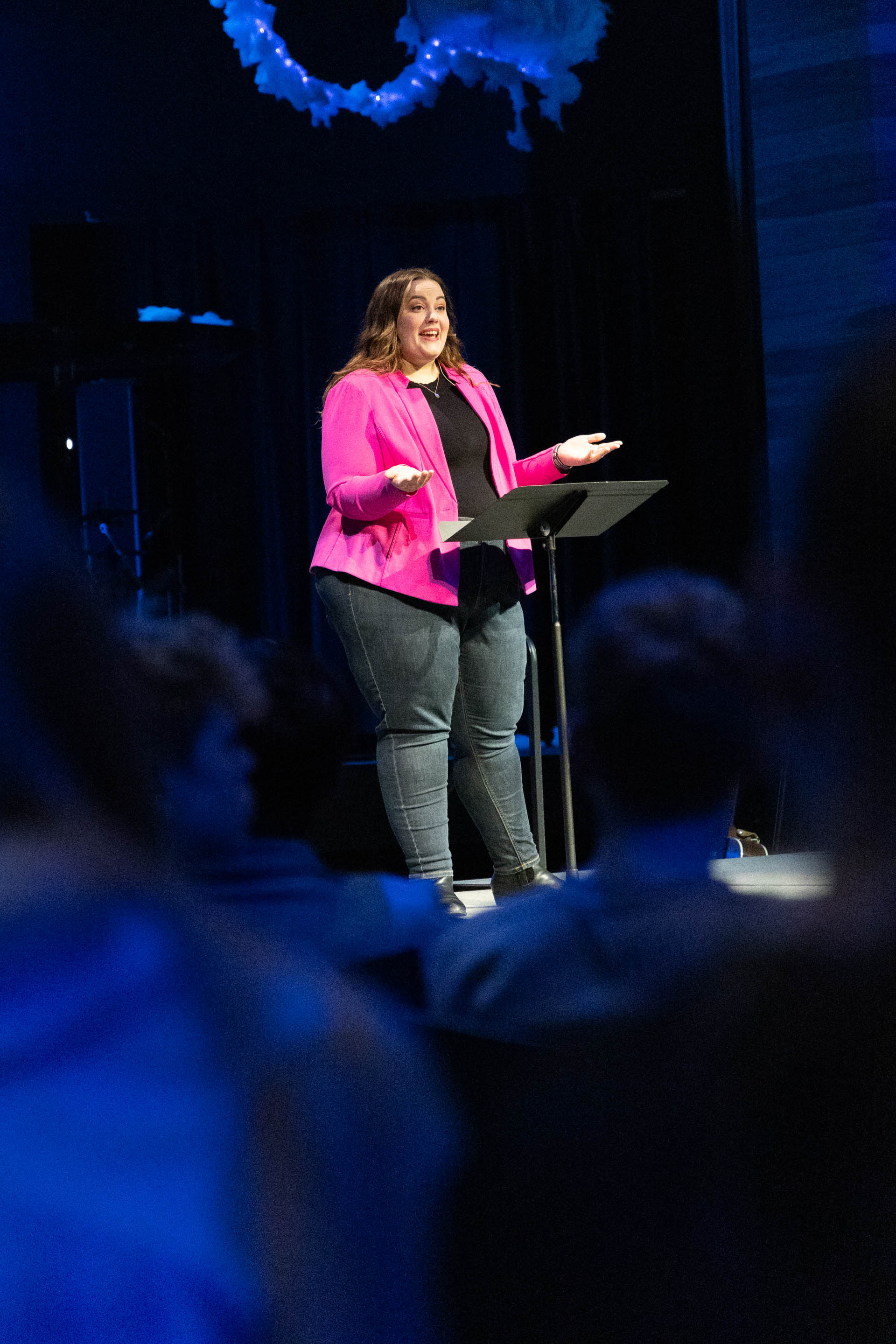
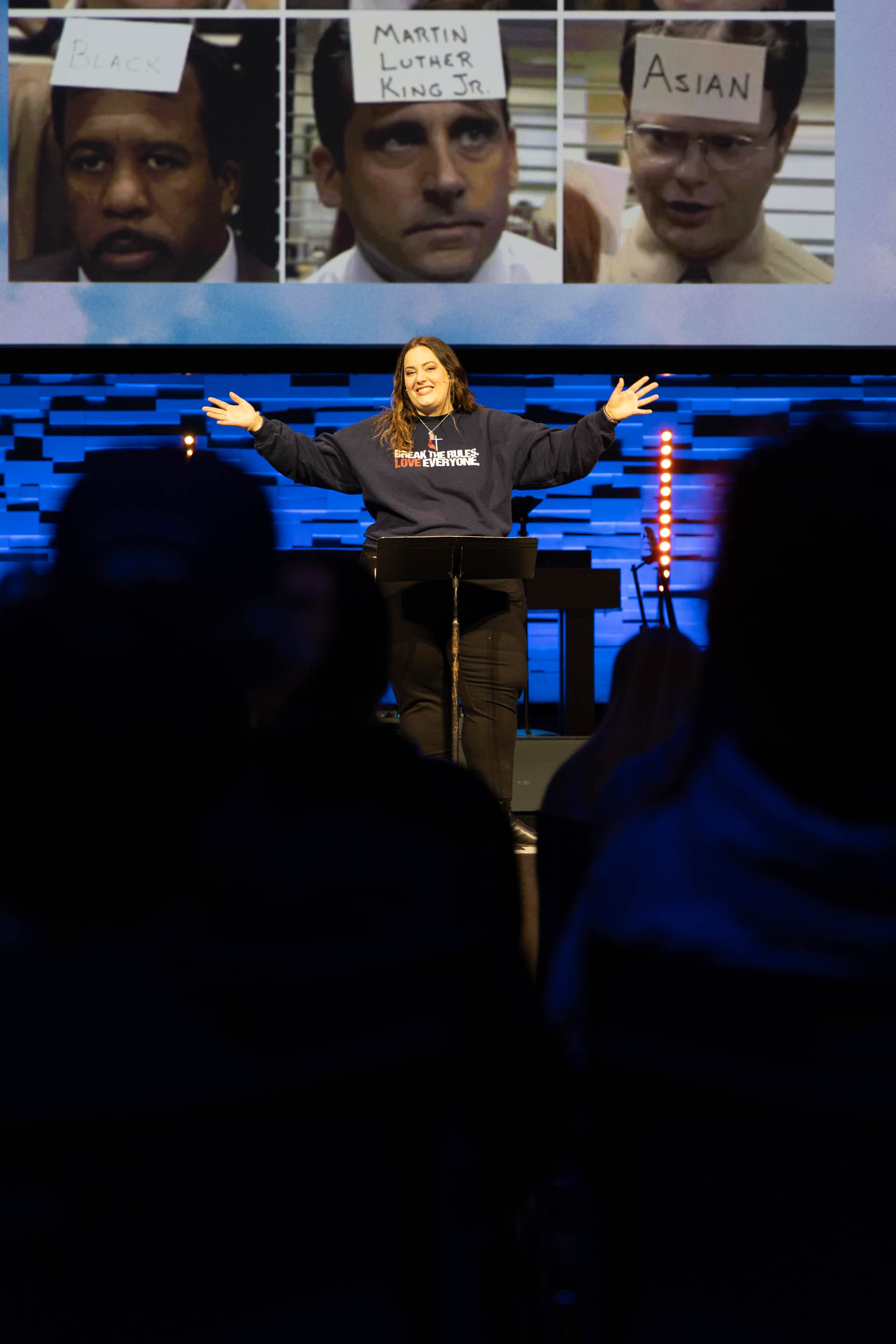
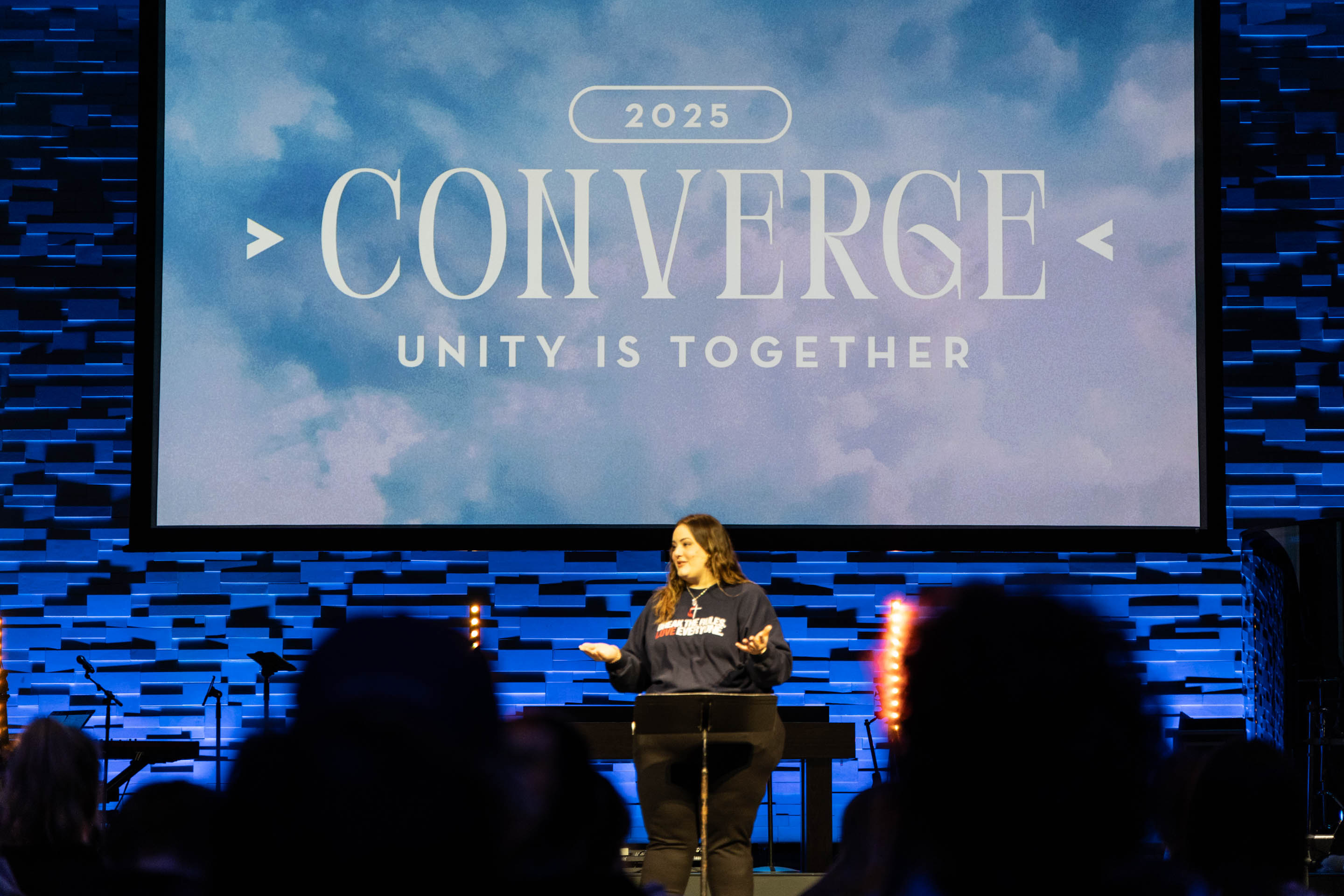
This spring, I had the honor of speaking at the first-ever Converge Conference—a collaboration between Church of the Resurrection in Kansas City and the United Methodist Conferences of Missouri and Great Plains. With students and leaders from across Kansas, Missouri, and Nebraska gathering under one roof, we leaned into a theme that’s as timely as it is tough: unity.

Let’s be real—unity is not an easy topic in our world right now. We’re divided by politics, theology, race, identity, class, and more. Even in the Church, Sunday mornings often reflect more division than unity. So, when I was invited to speak on this subject, I didn’t take the challenge lightly.

Across three sessions, I explored what it means to truly converge—to come together from different places, perspectives, and personalities—and find common ground in Christ.

In the first session, we looked at how Jesus gathered his disciples in Mark 3. These were not carbon copies. He called fishermen, a tax collector, and a Zealot—people who, under normal circumstances, would’ve had every reason to avoid each other. But Jesus didn’t call them because they were alike. He called them into a mission that was bigger than their differences. The disciples converged not because they thought the same way, but because they trusted the same Savior.

In the second session, we wrestled with how unity doesn’t come naturally. The disciples argued over who was the greatest—even after witnessing miracles. We’re not so different. We all want to be heard, to be right, to be safe. But unity requires more: respect, honesty, humility, and mercy. We found inspiration in Bishop Mariann Budde’s sermon at the National Prayer Service, where she reminded us that unity must be built on the dignity of every human being, a commitment to truth, and a spirit of compassion. Her words echoed the vows of our baptismal covenant and gave us a framework for what real Christian unity can look like.

We also explored real-world examples, like the Evangelical Immigration Table—a coalition of Christian leaders from across the political and theological spectrum who are working together to advocate for compassionate immigration reform. They don’t agree on everything. But they agree that families should be together, that people are made in the image of God, and that fear should never drive policy. This, too, is unity. Not uniformity, but a shared commitment to love and justice. If they can come together across so many divides for a common good, maybe we can too.

In our final session, we turned to the story of the Good Samaritan and Jesus’ challenge to “go and do likewise.” I reminded students that our baptismal covenant is more than a Sunday ritual—it’s our shared mission: to recognize the image of God in every person, to resist injustice, and to co-create a world that looks more like heaven.

One moment I’ll never forget: we invited students to create bracelets during the last session—braided strands that represented different colors, different people, coming together to form something stronger. At the end, we encouraged them to exchange bracelets with someone they hadn’t talked to yet. It was such a simple act, but it held deep meaning. Because when we converge and intertwine our stories, we are stronger than we ever could be alone.

Unity isn’t about agreement. It’s about commitment. A commitment to see each other as sacred, to listen even when we don’t understand, to fight for the dignity of others even when our experiences differ. It asks us to show up with humility and curiosity. To be people who ask, “What’s underneath the surface?” before we judge.

As someone who’s journeyed through four denominations in my own faith story—Southern Baptist, Presbyterian, Methodist, and now Episcopal—I know firsthand how difficult and holy this work is. I used to get angry at people who believed the things I used to believe. But over time, I’ve learned that transformation doesn’t require contempt. It requires mercy. It requires looking at someone across the aisle and saying, “You’re still God’s child. And so am I.”

This weekend didn’t resolve all our differences. It didn’t hand us a five-step plan to achieve world peace. But it gave us a meeting point. A reminder that we all have a place at the table. And that’s a holy start.

Crafting Inclusive Safety Policies for LGBTQIA+ Youth

LGBTQ, Theology, youth ministry

One of the most common questions I see in youth ministry Facebook groups is: “How do I create a safety policy that fully includes and protects LGBTQIA+ teenagers?”

A few years ago, I noticed more queer youth showing up in the congregation I served. As I listened to them, I realized some of our well-meaning practices were falling short of true inclusion: gendered small groups, gendered sleeping arrangements, name tags with birth names, binary restrooms—you name it.

What I love about this generation is that they’ll tell you when you miss the mark. I had teenagers say, “Heather, you say this church is inclusive, but…”

So I turned to the experts. I reached out to Indiana Youth Group—a local nonprofit creating safe, inclusive, nonreligious spaces for teens. They schooled me (gently but thoroughly!) and helped me draft a policy that aligned with best practices and deep care.

These policies were originally written for my church at the time (a Methodist congregation), and since then, they’ve been adapted by UMC, Episcopal, Presbyterian, and Lutheran communities. My hope is that they’re helpful to others crafting inclusive policies for youth. Please feel free to adapt them—no attribution needed. I’m simply paying forward what was so generously shared with me.

General Guidelines:

  • At [Church Name], we affirm that every person is made in the image of God and deeply beloved—regardless of gender identity or sexual orientation. We are committed to building a ministry environment where LGBTQIA+ youth are not only safe, but celebrated as whole and holy.
  • All staff and volunteers will receive training on LGBTQIA+ inclusion, including appropriate language, confidentiality, and how to respond to microaggressions or harassment. This training is required prior to serving in any capacity with youth.
  • Never assume someone’s sexual orientation or gender identity. Youth identities can be fluid—so listen with openness and curiosity.
  • Avoid reinforcing gender stereotypes in conversation, leadership, or activities.
  • Always affirm a young person’s chosen name and pronouns.
  • Respect privacy. If a child or youth shares their identity with you confidentially, keep that trust. Share only with the appropriate staff if necessary for care or support. Staff will not disclose a student’s sexual orientation or gender identity to parents/guardians without the student’s express consent. If a youth shares this information with you, you may offer to support them in telling their parents, but must honor their privacy unless a safety risk exists.
  • Parents/guardians are not required to disclose if their child is transgender. However, if they feel comfortable doing so, sharing this information helps our team provide a more thoughtful and affirming experience.

Restrooms and Overnights:

  • Our goal is to make gender-neutral restrooms and sleeping accommodations the standard, not the exception. This best practice ensures inclusivity for youth across the gender spectrum, helps all participants feel seen, and reduces the burden of disclosure or the need for special arrangements.
  • Youth who are gay, lesbian, or bisexual may use restrooms and stay in sleeping arrangements consistent with their biological gender.
  • Youth who are transgender or gender-fluid may use the restroom and overnight accommodations consistent with their gender identity.
  • Always defer to compassion and dignity when navigating these decisions. If questions arise, consult staff.

Group Assignments:

  • Best practice is to avoid splitting youth into gendered groups by default. Gendered activities can unintentionally exclude or cause discomfort for LGBTQIA+ youth. Whenever possible, create groups based on age, interests, or other non-gendered criteria.
  • That said, we recognize that some youth do enjoy the camaraderie of gender-specific groups. At the start of the year, offer all youth the option to choose between female, male, or gender-inclusive small groups.
  • Ensure all groups, regardless of gender composition, are safe, respectful, and affirming spaces.
  • Leaders are trained to create environments free from homophobia, bullying, or exclusionary behavior. There is zero tolerance for harm.

Responding to Violations

Disrespectful behavior, harassment, or bullying based on gender identity or sexual orientation will not be tolerated. Any reports of such behavior will be taken seriously and handled in a timely and confidential manner.

  • If between youth: Pastoral staff will meet with all involved to assess impact, offer care, and, when appropriate, guide restorative conversations.
  • If involving an adult volunteer or staff: The supervising leader will follow up within 24 hours. Disciplinary action may include reassignment or removal from their role.

Navigating Faith and Sexuality: A New Curriculum

lessons, Ministry, youth ministry

I grew up in purity culture. I wore the ring. I signed the commitment card. I was handed a box that supposedly represented my virginity and was told not to open it until I got married. Believe it or not, I still have all of it tucked away somewhere—relics of a theology that taught me rules, but not reflection.

Then I started working in mainline churches. And I realized something: progressives don’t talk about sex in church. Or so I thought. Working in progressive church spaces is funny; I’d have one parent say, “Don’t you dare tell my kid that sex is a sin,” and another say, “Can you please tell my teen to stop having sex?” I couldn’t win. And honestly? Neither could our students.

So my assistant director and I decided to do something about it. We created a four-week curriculum on faith and sexuality—one that speaks honestly, affirms LGBTQIA+ identities, and offers students something better than silence or shame. We rooted the series in the Wesleyan Quadrilateral, a framework that invites students to consider Scripture, Tradition, Reason, and Experience when wrestling with life’s big questions—especially when the Bible isn’t crystal clear.

Does God care about our sexual lives? Yes. Because God cares about our whole lives. But what God says about sex isn’t always as black-and-white as we were told growing up. That’s why this curriculum doesn’t aim to give every student the same answer—but to equip them with tools to form their own faithful, thoughtful, Spirit-led convictions. Spoiler alert: those convictions might look different for each student. And honestly? That’s the hope.

After we shared this series with our own students, it was picked up by Reconciling Ministries Network—an affirming branch of the United Methodist Church—and is now being shared with churches across the country. Our prayer is that this becomes a flexible resource for your ministry too. Feel free to adapt, edit, and shape it to meet your context.

Just—whatever you do—don’t stay silent. Our teens are listening. Let’s make sure they hear something worth holding on to.

Series Overview

Week 1: Developing a Faithful & Healthy Sexual Ethic

Bottom Line: We should view sex through a Christian worldview.
This week introduces the Wesleyan Quadrilateral—Scripture, Tradition, Reason, and Experience—as a framework for building a personal sexual ethic. Instead of issuing rules, it invites students to wrestle with how their faith informs decision-making. The big message? Your faith can and should shape your view of sex, but it’s not about fear or shame—it’s about trust, wisdom, and grace.


Week 2: Called to a Higher Standard

Bottom Line: As Christians, we are called to a higher standard. However, we are not to shame others for their decisions.
In this session, we explore how following Jesus means choosing what’s beneficial, not just what’s acceptable. We talk about being intentional in our relationships, valuing people over objectifying them, and embracing grace instead of shame—both for ourselves and others.


Week 3: Valuing Others vs. Objectifying Others

Bottom Line: As Christians, we are called to value others, not objectify them.
This week dives deeper into two key areas: lust and pornography, and consent. It challenges students to think critically about how culture influences their views on sex, and affirms that healthy desire isn’t wrong—but using others for gratification is. We also unpack the dangers of porn, the importance of consent, and why we’re called to treat others with dignity and respect in every interaction.


Week 4: Pastor Panel Q&A

Bottom Line: Pastors answer your questions about faith and sex.
This week is dedicated to your students’ real questions—everything from “Is masturbation a sin?” to “What if I’ve experienced sexual abuse?” to “What does the Bible say about being queer and sexual?” A panel of pastors responds with love, honesty, and theology rooted in grace. This week models what it looks like to have vulnerable, faithful conversations about complicated topics—without fear and without shame.

Download Here:

Bob Ross Painting Night!

games, Resources, Uncategorized, youth ministry

Hi friends!

It has been a LONG TIME since I have posted, HOWEVER I did something really cool with students at our Overnighter last month, and I wanted to share it with you here!

First of all — I LOVE Overnighters, and I realize I’m overdue with an “official” post on why they are so great, and what we do at them! But the basic trick to them is this: scheduling something every hourish to keep students engaged. This year, we added “Bob Ross” hour at 2am! That’s right, 100 middle schoolers were invited to paint along to a Bob Ross Video at TWO A.M. And you know what? It was a SUCCESS!

HERE’S HOW I PREPPED:

The most important part was choosing the right video. I wanted it to be simple enough we could follow along — especially since “real” painters use a variety of brushes and paint colors. Here is the video I chose:

HERE’S WHAT I PURCHASED:

  • Paint Tray Palettes. You could also, of course, use paper plates — but this was a really easy way for us to issue paint to students!
  • Spatulas. We also used plastic knives too — which worked just fine.
  • Fan Brushes. This is a variety pack — the size differences did not seem to matter.
  • Acrylic paint. Bob uses oil paint, but that was not realistic when painting with students. I purchased 3 cases for around 65 paintings. We only used one, and maybe an additional white.
  • One-inch brushes. Bob uses 2-inch brushes, but since we use a very tiny canvas, this worked better for us!
  • 8×10 Canvas – This was the best bang for our buck, and worked just fine for our paintings. Each size item we purchased accompanied this size canvas perfectly.
  • Flat Brushes – I don’t think Bob actually uses anything like this, but it’s nice to have a “normal” paint brush.

HERE’S WHAT WE DID:

  • On each table, we set up cups of water, paper towels, and extra plates so that students could use them to blend colors
  • We learned the hard way: You should also put down plastic tablecloths or butcher paper.
  • On the Palettes, we put white in the center. Then we used the rest of the colors for the other holes. The only colors you don’t need are pink and orange. We also had adults do this — it was easier to create an assembly line than have students do theirs themselves.
  • We passed out canvas and permanent markers first and told students to sign their names on the back. The canvases we used give space for students to even name their paintings!
  • I led this activity, and painted along. I would tell students to listen to Bob fully, then I’d pause it after he did something and allow students to catch up.
  • We let students “skip” painting the parts that they didn’t love. As it gets to the end and Bob starts doing the bushes and the path, it doesn’t make sense at first. This would be an awesome thing to preach on, if you have a message that evening! Sometimes you can’t see what God is doing, but if you go along with it you might get something beautiful and unexpected.

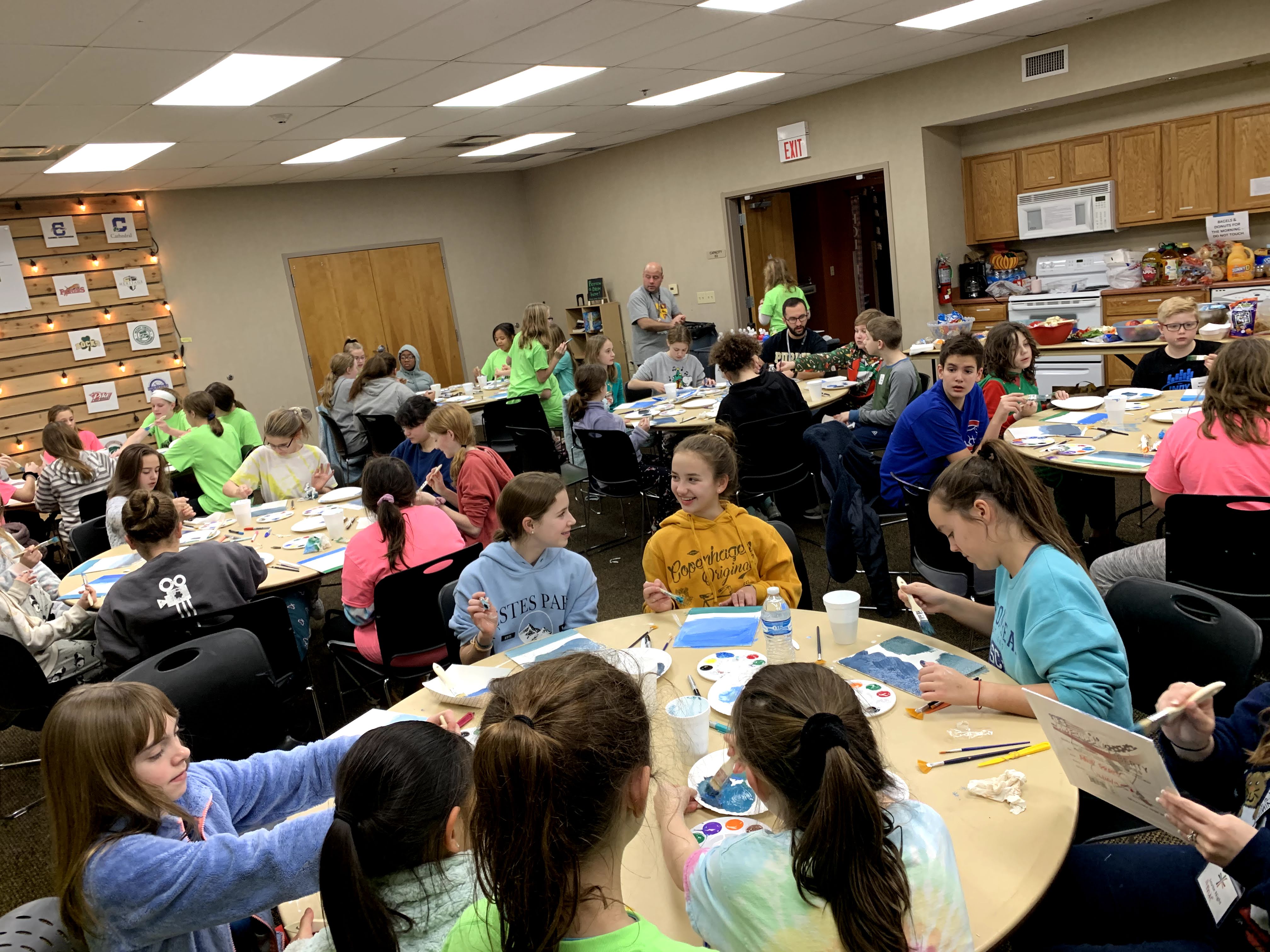
Here is a look at my painting (the best art I’ve ever done!) and a few other pictures of our activity!

IMG_1524
IMG_1519
IMG_1520
IMG_1521

I would 10/10 do again! We finished around 3am, and they were dried and ready by 7am. We had several kids get frustrated (our boys, let’s be honest) and trashed so they could play foosball or “reinterpreted” their paintings, as you can see. But overall, everyone loved the activity.

Some Fall Games I’ve been playing!

games, Ministry, youth ministry

I haven’t posted in a while; I got married last month! I’ll post some pictures soon (and I’m excited to tell you our love story).

I just wanted to pop in to share a few of the games that we have been playing in our middle school ministry this fall. They’re a little random, but a total blast. Feel free to use any of this material, including the graphics, which I created quickly in Canva.

Gobble Hobble.png

The “Gobble Hobble” is the name I gave this game in a frenzy this last Sunday morning, when everything was going wrong and I needed to come up with a quick game. I remembered playing a version of this a few years ago and wanted to give it a quick funny name. Best part: It takes 3 minutes to prep.

Choose one person (we chose 4 — one from each grade) to go out into the hall and be blindfolded by a leader. Tell the group to, together, hid a “turkey.” The “turkey” can be anything, as long as you can decipher it with a blindfold on. In a pinch, we used a basketball. Invite the blindfolded person in, and lead them to the “turkey” only using “gobbles.” The same way you’d play hot-or-cold, the closer they get to the “turkey,” the more the crowd gobbles. First person to get to the “turkey” wins. It was complicated playing with four people, because no one knew if they were correct when we were gobbling. It worked out for us, though, and we were able to play two rounds (with instructions) in less than 7 minutes. Not a bad way to start off a Sunday morning!

dice wars.pngDice Wars is another great game — otherwise known as “1 to 100.” Since we are in a multi-purpose space, sometimes we find out last-minute that we have to switch to round tables for an event right after our youth group. That’s how I came up with this game. Here are a few games — that I, truthfully, copied and pasted from the internet. There are tons more games, too!

What you need: Each player needs a piece of paper to write on. You also need one die and one pen.

How to play: Everyone sits in a circle, either around a table or on the floor. One person starts out with the pen, and the person to their left starts out with the die.

Let’s say Paul has the pen, Tasha is to his left with the die, and Adam is sitting to Tasha’s left. When the game starts, Paul starts writing legible numbers, starting with 1 and going up to 100, as fast as he can on his paper, while Tasha starts rolling the die as fast as she can, trying to roll a six. As soon as she does roll a six, she gets to grab the pen from Paul and start writing numbers on her paper, while Adam grabs the die and tries to roll a six. As soon as he does, he grabs the pen, and the person to his left starts rolling. Play proceeds around the circle like this. The next time Paul gets the pen, he starts writing where he left off. The first person to write to 100 on their paper wins.

FALL PARTY GAME.pngI love puns, and I was inspired by a Buzzfeed post to create this game. I used some from Buzzfeed, some from elsewhere.

Click here to access my link from Canva, and edit or download for yourself!

FIND SOMEONE.png

This was a game I used at the beginning of the school year, in order for students to make some new connections. It was a blast, and a traditional youth ministry favorite!

Click here to download and edit from Canva.

“The Awesome Game”

games, youth ministry

A few years ago on our mission trip, we played a game one evening called “The Awesome Game” when a different outing was cancelled. We had THE MOST HILARIOUS time, and now it has become a staple for our youth ministry on Kickoff Sunday.

Here’s what you do:

  • Type up a list of different challenges — I’ll share mine below. You want these challenges to be a mix of things. You want to do some things that cause them to get to know one another, some that give good photo or video opportunities, or some that are just OBNOXIOUS.
  • Cut up those pieces of papers, and put one copy in a gallon-sized plastic bag.
  • Split your students up into groups (we did small groups). Give each group a bag and a time limit (anywhere between 30 and 60 minutes).
  • Give some way for them to count what they’ve done — give them another bag, tell them to ball up the ones they’re done with, or put the ones they’ve done in your pocket.
  • At the end of the time, the team that has done the most wins!

Here are some examples of challenges you can place in the bag:

  • Make a two-minute video talking about your love for cheese
  • Interrupt another Small Group completing their challenge.
  • Run around for 60 seconds yelling “We won! We won!”
  • Come up with a team chant
  • Join in another Small Group completing their challenge
  • SOMETHING STINKS! Walk around the room for 60 seconds and act like you’re trying to find the smell. Get obnoxious!
  • TIME TO PROPOSE! Have two people give a two-minute proposal, with everyone else encouraging them to break up.
  • Create your own “challenge” like Ice Bucket Challenge or  KeKe Challenge. Make a one-minute video inviting people to take part in your challenge.
  • Spell out MSM (for Middle School Ministry) on the floor by laying down!
  • FORM A BAND: Sing a nursery rhyme at the top of your lungs using full air-band motions and sounds
  • Go to the Ga-Ga pits outside and play one round of Ga-Ga Ball (basically–hitting the ball and not getting hit in the feet–if you get hit, you’re out!)
  • Play Duck-Duck-Goose for 2 minutes
  • Challenge another group to a dance battle. Battle it out for two minutes, even if they don’t participate back.
  • Run up behind other players and make farting noises for an entire minute.
  • I’m not crazy–you’re crazy. Create a straight jacket that one person must wear for the remainder of the game.
  • Choose one person to stand on one foot for the remainder of the game
  • GET ON ALL FOURS! Each person choose a different farm animal and act it out for one minute.
  • MAKE A PROMO VIDEO: Choose an accent and talk about why Middle School Ministry is awesome for an entire minute.
  • Each person must do 10 jumping jacks.
  • Do a runway walk from one end of the Great Hall to another
  • Have one person pretend like they’re underwater until the next challenge is completed
  • Try to get another group to dance like robots with you.
  • Each person talk to another person on your team like they’re your celebrity crush
  • Pretend like your clothes itch. Scratch, roll on the floor…JUST GET IT OFF!
  • Run up to another group. Narrate their challenge like a Sports Announcer
  • Have everyone spin around 5 times, then walk ten steps in a straight line
  • Run up to another group and tell them “YOU MADE ME CRY” and drag it out until they ask why!
  • Choose one player to talk like a cat the rest of the morning.
  • Run up to another group and ask them if they believe in fairies until someone says yes!
  • VROOM VROOM. It’s the Indy 500! We’ll let you off with just one lap, though: run one lap around the gym.
  • 1,2,3,4, I declare a thumb war! Have a thumb wars tournament. The winner gets cheered by the rest of the group!
  • Go around the circle and say your FULL NAME–INCLUDING MIDDLE!
  • Create a new Yoga pose and give it a name! Everyone must do the yoga pose.
  • RAP TIME. One person raps while everyone else beatboxes.
  • Choose a fitness instructor–lead the group in a workout routine for an entire minute!
  • TIME FOR THE GREAT DEBATE: Debate for two minutes on whether you are pro-pickle or anti-pickle.
  • TIME TO RAGE: Run up to another group, and start a mosh pit! (for those of you youngins…that means to jump up and down, bumping into other people)
  • Pick a random object in the room and make a one-minute commercial for it.
  • Start a back-rub train: Each person must rub the shoulders of the person in front of them. Once you’ve rubbed for 30 seconds, turn around and rub the other person’s shoulders.
  • Start a conga line–take one lap together around the gym.

Here are some videos from our adventures:

Grass Eating Challenge for @ywmissions . We tag THE WORLD.

A post shared by St Luke’s Middle School Min (@stlukesmsm) on

We love Playdoh. @ywmissions

A post shared by St Luke’s Middle School Min (@stlukesmsm) on


Let me know if you try it!

Best moments from Summer 2018!

junior high ministry, youth ministry

This has been THE BEST summer of ministry I’ve ever experienced. I wanted to write a blog about one or two of my favorite moments, but found myself lost for words. So, here, in no less than 1600 words, are my favorite moments from this summer:

  1. Last summer we started a tradition that I call “Huddles with Heather.” Each Wednesday students can meet me at a local Frozen Yogurt place called Huddles, and we eat ice cream and chat. Last year we had, at the most, a dozen people. This year, we had no fewer than a dozen each week, sometimes hitting 20-25 people PLUS all the parents and students who came to hang out!
  2. Huddles was so awesome, that my summer intern and I made “Huddles with Heather” tank tops. We only printed 12, and they became the most coveted item of the summer.
  3. At Vacation Bible School, I led games for preschoolers (don’t laugh!). There was an awesome snack area for leaders to take a break in. There was a gaggle of 5th graders who were volunteering that week, and I got to know them–they were very interested in pictures of my cat. Since the fifth graders had only been in my middle school ministry two weeks, I didn’t know them super well. They came to Huddles that week, and brought friends with them. All of their friends ended up signing up for Mayhem!
  4. Each summer we do Middle School Mayhem. The following memories are from it. Watch this video to see more.
  5. There was a 5th grade girl who was crying and could not be calmed down by her fantastic student leader. I asked her what was wrong, and she said that her friend died last year, and today was his birthday. I gave her a hug as she cried, and I asked how he died. She said he committed suicide. From there, I took her into our office, and sat on the couch with her as she bawled her eyes out. She shared that he was bullied heavily, and the people who bullied him began bullying her for being sad he’s gone. She shared about the birthday party he had planned for that day, his 11th birthday. From there, I decided we’d have a birthday party. One of our leaders grabbed a piece of cake from a local place, and that student, her leader, and I had a “birthday party” in my office, huddled around a piece of chocolate cake, sharing stories and asking questions about her friend. It was one of the most holy things I’ve ever experienced. Because kids shouldn’t die that early. And we should give space for kids to grieve that stuff.
  6. There were a few 6th grade boys who LOVED our devotion times this year at Mayhem (a struggle in previous years to get kids to settle down). They wanted more than 20 minutes of quiet time so they could “meditate” after finishing their journals.
  7. I’ve been investing some time into a 6th grade girl, and she made me an entire “Photo Gallery” of different sketches of things–her Bible, our Mayhem logo, a picture of me, some words that describe me, and things like that. Then, later that week, she wrote me two notes: one that described how thankful she was for our relationship, and another expressing a really heavy prayer request because she “just wanted another person to know.” How fantastic that students can come to the church with that stuff.
  8. The Pink Team was KILLER this year. I had an entire Tribe of 7th grade girls, and gave them the color pink. They created an entire Pink cave complete with so much pink, I literally had to sit down to absorb it all. Although the girls were a little points-hungry at times, their leader kept them humble and with a positive attitude.
  9. A student leader expressed to me the week before, during set up, that she was interested in youth ministry…even middle school ministry. Somehow, through the holy spirit, we decided that she should teach during Mayhem…to over 100 people! For her first sermon! And she CRUSHED IT. Her tribe even created a poster for her, signed by everyone on the tribe, to cheer her on.
  10. Another student leader baked an entire sheet cake with his father, and brought it to Mayhem on the last day to share with his tribe. It was such a huge cake, that he was able to share it with the group. Nobody could believe that he actually made it, it was so impressive.
  11. ALL of my student leaders impressed me LEAPS AND BOUNDS THIS WEEK. Holy cow. Each one of them served at the level of an adult, with such poise an maturity.
  12. We had 3 busses try to break down on us, but not once did it ruin or plans or make us late. Praise God!
  13. This year we added “Yay Gods” and “shoutout” to our daily routine, something we do on our YouthWorks Mission Trips. The kids loved it and anticipated it each day.
  14. Each year I get rained out of the local swim park. This year we were able to book a fantastic side plan, going to a local place for bowling and laser tag. The students had a blast.
  15. With each student who “got in trouble,” we were able to preserve the relationship and adjust their experience so that they felt successful that week. Such a success and God thing.
  16. OUR ORBEEZ POOL WORKED. We had a dream of filling a swimming pool full of water beads. It definitely failed during our test period (the pool popped) but the students LOVED IT. Oh yeah, and no one threw up in the foam pit this year.
  17. Last year I had a 7th grade girl who drew me as Willy Wonka (our theme was Chocolate Factory). This year she made me a new drawing, and everyone was so excited to see her next installment. Before you know it, my office will be her official art gallery and I LOVE IT.
  18. We had two new adult leaders this year, who totally dug and understood the middle school age. One of them had a particularly tough group, but never complained, even though he was going home to two babies each night.
  19. MISSION TRIP memories to follow from here — which this year, we brought 41 students and leaders on! My first year here, I definitely brought seven. Ha!
  20. One night during small groups, I overheard a small group leader saying to a girl “own it!” I heard the girl say, “I could maybe be a pastor.” The small group leader said “don’t say maybe!” and the girl responded “i could be a pastor!” That girl then told me that she was considering ministry. On the last night of the trip, she stood in front of our entire church group and told them that she might be a pastor when she grows up!
  21. The boy who needed space to think, and stepped out of small groups time. Talking to him, I learned he’d had a rough year, and had some doubts. He was thankful that our church didn’t teach black-and-white theology. He still seemed unsettled. During the last night of the trip, he stood up and told the group that through death and heartbreak in his family, he knew he could always come back to St. Luke’s and find a home here.
  22. The siblings who never separated from each other before, but found their separate identities at the trip.
  23. The group of girls who embraced another girl, even though she kept pushing them away and attempting to be a loner.
  24. After the mission trip, I asked students to send me on Instagram stories of how their Small Group Leaders have impacted their lives. One girl messaged me, saying that her SGL influences her to consider how ministry could be a part of her vocation–making this the fourth girl of the summer, and the sixth in eight months to tell me that she’s exploring ministry vocationally!
  25. This year, I didn’t have to argue with a single kid about showering. God works in all things, big and small stinky!
  26. On the mission trip this year was an 9th grader who, in 7th grade, had to “quit” Confirmation because some things came up. I really didn’t want her to quit, because I knew she’d be separated from her friends if she repeated the year, with the kids a year younger than her. This last year she was a great Student Leader for the 7th graders, and was very nervous about going on the mission trip this summer. She reconnected easily with her 9th grade friends, and on the last night, stood them in front of the entire room and told of their loyalty and kindness.
  27. Two of our pastors are leaving the church, and taking their incoming  7th grade daughter with them. She came on the mission trip, bringing her entire entourage with them. I was concerned it might be tough, spending a “last week” with them… but the group celebrated her and her family, and as an entire group we sent this girl off with an emotional prayer. She’s going to be a cornerstone at her new church, and we’ll miss her. But it was awesome.
  28. There was another young lady, who came on this trip, but had never come to St. Luke’s before. She said to me, “Are all Methodists like this? You guys are so kind, and emotional. Lutherans aren’t like this.” I joked with her that mission trips get emotional for everyone, but she was able to pinpoint something special about our group. And I mean… they are special.

I know that as soon as I hit “publish,” there are going to be several more things that pop up in my brain. This summer has been SPECTACULAR, and if you read every word, I want to thank you for celebrating this summer with me. :)

DIY Trophies

Resources, youth ministry

This year for our annual “Confirmation Awards” (the awards I give to students who have actually completed all of their requirements), I decided to do something different and make trophies for each of the students who won!

This was such an easy DIY, and I learned some things, so here we go:

IMG_4111.jpg

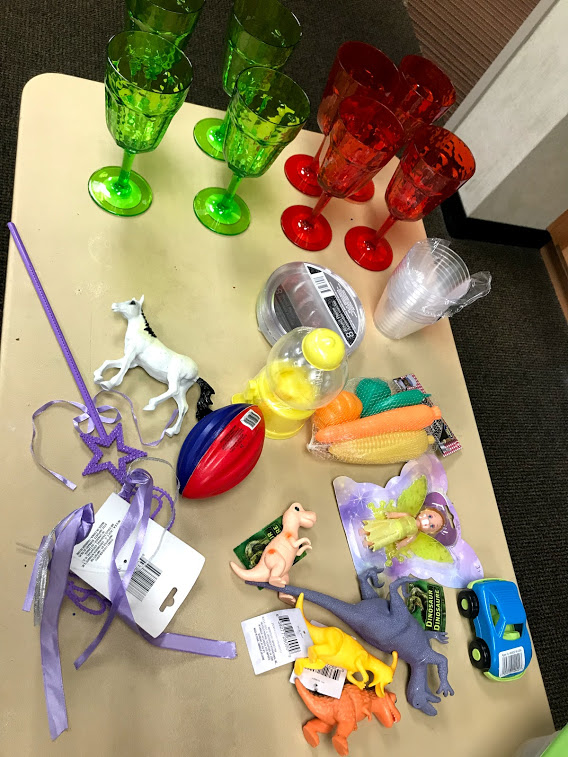
The first thing to do is collect your supplies. I went to the local Dollar Tree, where dreams are made.

IMG_4113.jpg

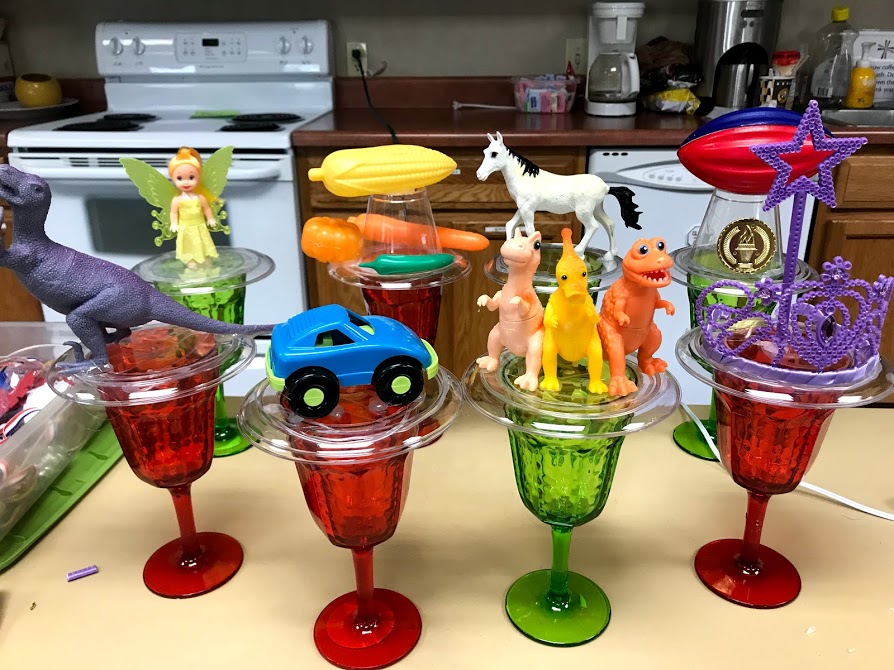
I hot-glued plastic plates onto plastic cups. I decided to double up the plastic plates, because I thought it made it sturdier and matched the texture of the cups more.

IMG_4114.jpg

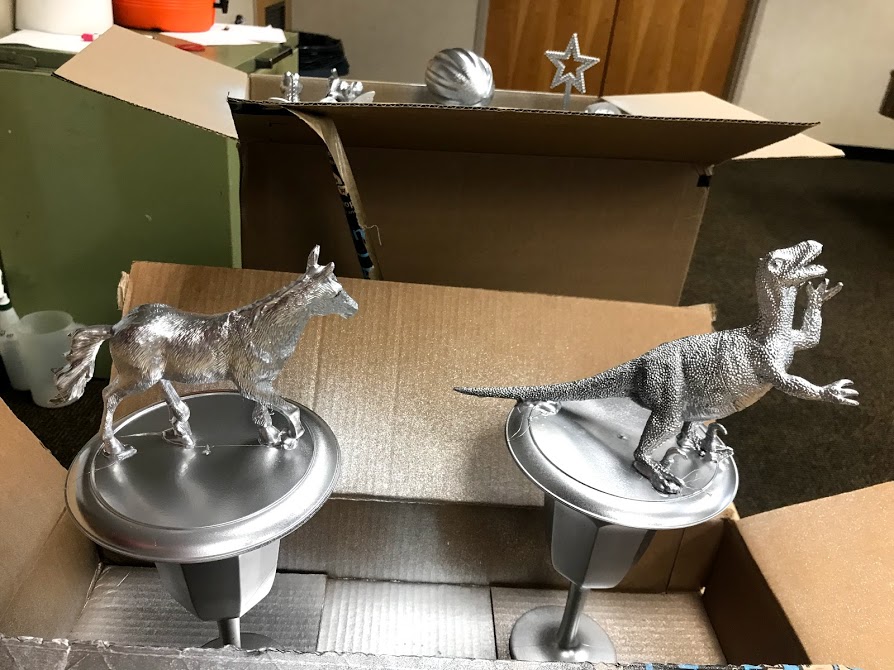
Then I hot-glued the various figures on top. For some of them, I added plastic cups that I found. For the football one, I hot-glued a “gold medal” to it. For the princess one, I broke the wand in half and hot glued it to the plate.

IMG_4116.JPG

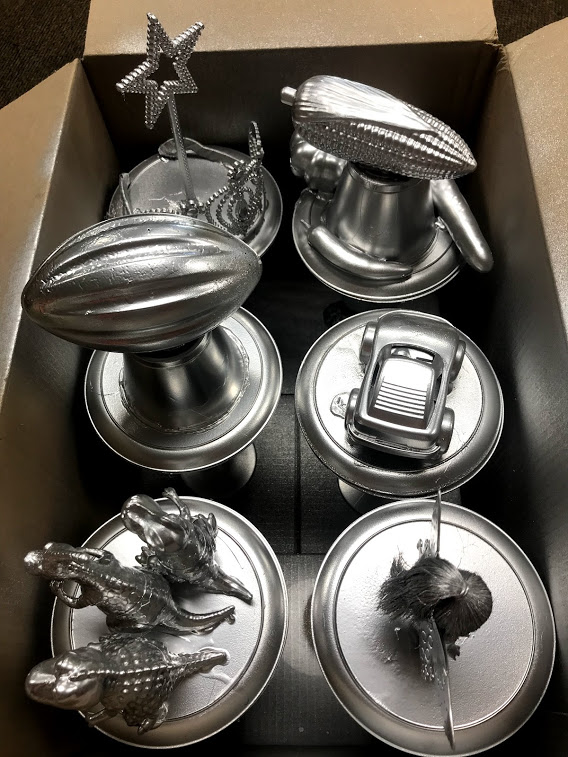
I spray-painted them after this. I noticed it was tough getting into some of the crevices, but if I spray-painted it from the bottom first, it made it easier. ALSO: DO NOT OVER-SPRAY PAINT. It gets tacky.

IMG_4117.jpg

Here they are! I wish I took better pictures, but this is how they ended up looking. My one regret, besides over-spray-painting, was not picking the hot glue off before I spray painted.

IMG_4121.jpg

Seriously easy! My favorite trophies were the dinosaur ones, and the corn one.

How I Plan Curriculum

curriculum, lessons, youth ministry

One of my biggest strengths is that I am a Master Curriculum Planner. In my setting, I kind of have to be. We have a Sunday School-style program in that because we have one main hour of programming each week, and we have Confirmation smack dab in the middle of our middle school years. So, we split off into three groups: 5th & 6th grade, 7th Grade Confirmation, and 8th grade. We still have large-group teaching and small groups, but each group has their own curriculum and discussion questions… which equals a lot of work! Fortunately, I’ve had the ability to work on it one or two years at a time, and refine the previous year’s as I work on a new year.

You might be saying, “Heather, why don’t you just purchase curriculum? That’s what it’s for!” My answer: I love most purchased curriculum out there. I’m a huge fan of Orange, Sparkhouse, LIVE, Credo Confirmation, The Thread by y360, and other comprehensive curriculums.

But for us, I assessed the needs of our context and decided to do a four-year comprehensive curriculum. 5th & 6th grade rotates Old & New Testaments, 7th grade does Confirmation, and 8th grade addresses their identity through Spiritual Gifts. You can read more about how I develop a long-term curriculum by reading my article published in YouthWorker Journal.

Here is a look at the way I format curriculum over the course of 4 years:

56 Year 1 – Old Testament
56 Year 2 – New Testament
7th Grade / Confirmation
8th Grade – Spiritual Gifts

On top of Sunday mornings, we also have lots of retreats–it’s one of the hallmarks of our ministry! I typically plan the curriculum for our retreats, as well as for Middle School Mayhem, our weeklong Day Camp. Again–I could buy curriculum for these events, and I do for some retreats. But for Middle School Mayhem, I like to mimic what is happening in Vacation Bible School since it happens the same week. This year we’re branching off from VBS week, so I may have more freedom in the future.

But again…I enjoy writing curriculum and am good at it.

Today I want to share my favorite way to plan curriculum over a series.

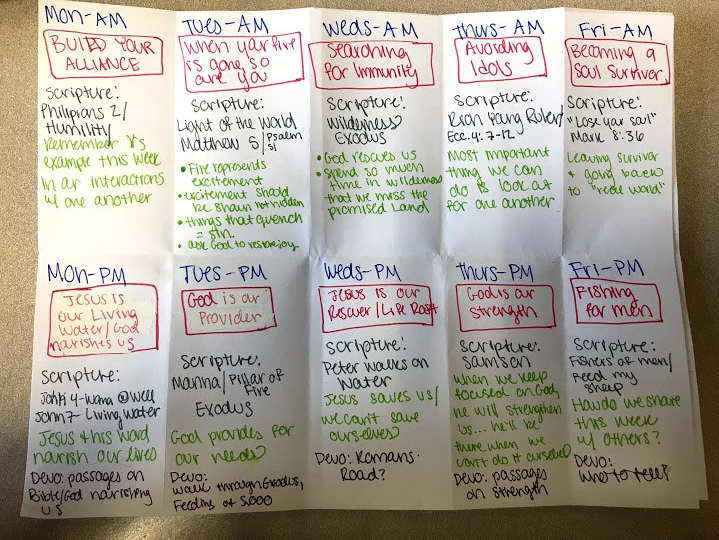
  1. Basically, I fold a piece of paper into the number of lessons that I need.
  2. I write the things that I need to plan: Date, Title, Bottom Line, Scripture, Notes, etc.
  3. Then, I fill in the blanks. My big secret for finding scriptures that match themes is the Topical Bible.

Easy, right? Here are some examples:

IMG_3891

This is how I planned our 8th grade year on Spiritual Gifts. I divided up the 15 gifts (from LeaderTreks) into 5 categories: Leaders, Teachers, Movers, Judgers, and & Helpers. Then I planned out some scriptures.

mayhem 2018

This is how I’m planning Mayhem for this upcoming summer! I’m drafting this on paper, then I’ll form it into a document (like the next two)

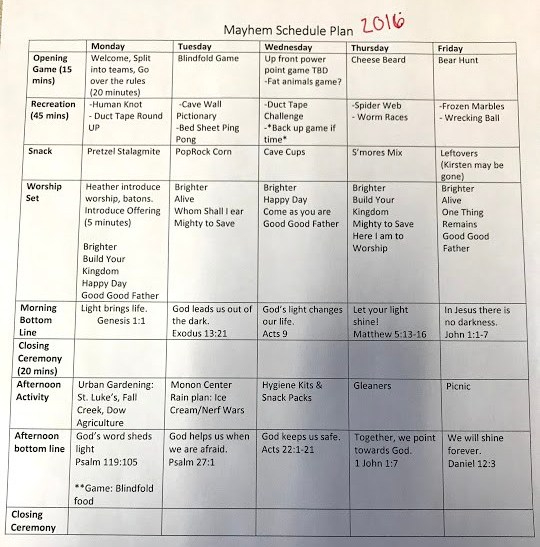
Mayhem 2015

This was our first year of creating Mayhem, a day camp, so this was my first way of formatting what I drafted on paper into a document, with additional details: like, notes and games. This year’s camp was MOUNTAIN themed!

Mayhem 2016

This year’s Mayhem was CAVE-themed. As you can see, I added “Snack” and some other categories to plan all aspects of the camp.

Hope this helps someone out there plan their pwn curriculum! For me, I always find looking at the week as one comprehensive piece and viewing its parts as part of a whole helpful. It’s allowed me to be really imaginative and thorough, whether the series has been exegetical or topical.

Cheers!