I wrote a post a little over 3 years ago for another blog site with this same title and similar content…but so much about the way I view and talk about women in ministry has changed. So I rewrote it and now it’s over at Youth Specialties.


I wrote a post a little over 3 years ago for another blog site with this same title and similar content…but so much about the way I view and talk about women in ministry has changed. So I rewrote it and now it’s over at Youth Specialties.
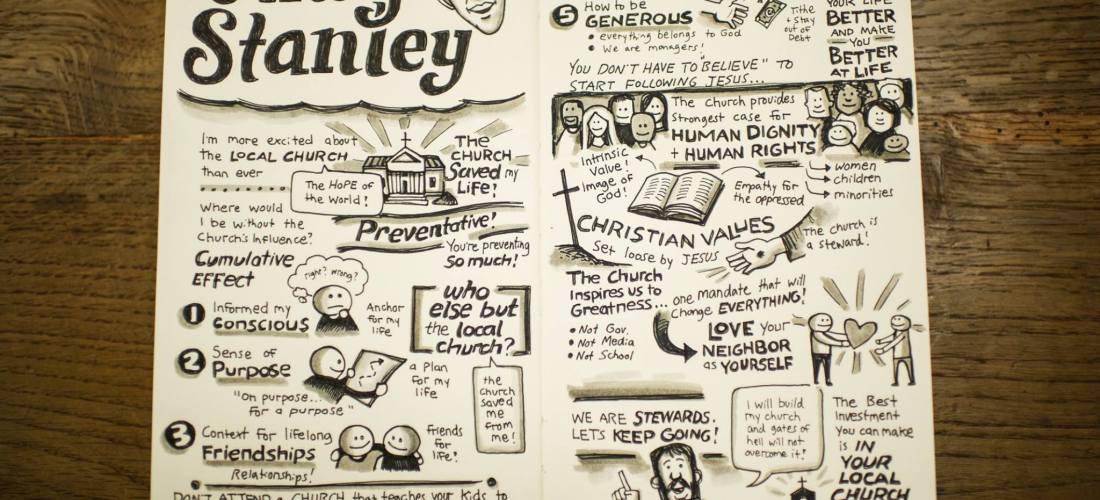
Image by the Sketch Effect.
My Orange Conference experience was a little strange this year–from the time I stepped onto the plane from the time I got back home to shower with no hot water…it was an odd year. :)
Usually when I go to any conference, I feel overwhelmed with all that I want to do in ministry. But this year, Orange was a time for me to reevaluate who I am in ministry.
The honest thing is that I’m in a season wrestling with God. I’m just really pissed at him right now. On the first day of the conference I journaled about it–lamenting that I’ve given up everything to follow my call to ministry, but that the things I desire most in the world (outside of my dream career) I do not have. And although I know that God is working in my ministry, it’s been hard to see him elsewhere. In short, everything that I have right now is wrapped up in the local church and I feel like I don’t have much to show for outside of it.
Of course, I am grateful for the local church and thankful for the work that I get to do. My prayers to God the past few months have been this simple: “God, you have given me all that I have. You have saved my life in every sense. I’d be nothing without the local church’s influence on my life. I’m frustrated and doubting you. But how can I not serve you back?”
I haven’t had much more else to say to God–just the verbal acknowledgement that I’m pushing through, even though I’m angry that I’m not getting my way when I feel like I’ve given all to give God his way.
Andy Stanley saved the day, per usual. He talked about how the local church saved his life. Andy said that the church has done and does all of this for us:
Andy argues that when you really dig into this, you realize that the church is the place that should set the tone for everything good in the world.
This is something I was processing before Orange–how good exists outside of the Church, but the Church, if properly following God’s love and Jesus’ example, should be the hub for all that is glorious and good in the world.
Reggie Joiner, the man behind Orange, said that when Jesus died on the cross, it validated everything he ever said about loving others. And that is why the church should be the best at this.
This is why I give everything I have for the Church. And why I’m getting over this self-absorbed lament that everything I have is wrapped up in the local church–when the truth is that the local church loves me incredibly and has taught me everything I know about loving others. To be wrapped up in the local church is kind of the goal. I missed that.


During Lent, our church has been focusing on prayer. This last Sunday I taught in our preteen ministry on listening to God. Doing a series on prayer has been very tricky with tweens–prayer is very abstract and tweens are very distracted. So teaching on listening to God? This girl must be crazy.
But I think it’s important, and so I do what I do best to teach biblical truths to middle schoolers: I tell a story about it.
The clearest time that God has ever spoken to me was when I was experiencing my call to ministry at the age of 17. This may strike you as crazy, but I didn’t always want to be a youth pastor.
(gasp)
I wanted to be Oprah.
As freshmen in high school, the big English project of the year was to do a paper on what we wanted our career to be when we grew up. I had no clue. I wanted to do something theatrical (if you know me, you aren’t surprised). I had gone through a lot of rough stuff, and so I knew that I wanted to help people. I also watched Oprah every day after school. She was so benevolent to others. I admired that. I decided that I was going to follow in her footsteps: I was going to go school for broadcast journalism, work my way up in the field, and eventually have my own talk show.
This made sense to everyone around me. So much sense, that I became Editor-In-Chief of the school newspaper. So much sense, that I won the senior superlative “Most Likely to Have Her Own Talk Show.”
I was on the Oprah track (okay, maybe not, but I wanted to believe it).
I was simultaneously extremely involved in my youth group. The church gave me refuge from my home and school life, and gave me identity as a struggling teen. I was involved in every aspect of the church, and I mean every. I sang on the worship team, played guitar, ushered, taught Sunday School, even praise-danced (say whattt?). I went on mission trips and was kind of my youth pastor’s side-kick.
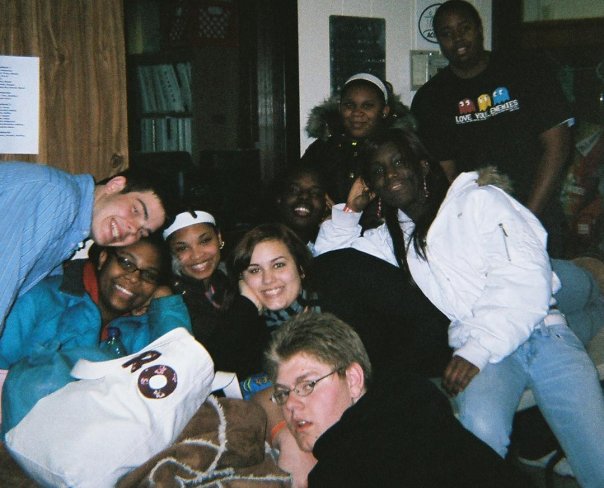
Me and the squad. My youth pastor has the Pac-Man shirt that says “Love Your Enemies” on it, naturally.
When I was in the middle of my junior year, my youth pastor said to me, “You know Heather…when you graduate, you should take over the youth group.
I laughed. And laughed. And laughed.
But there was also a nudge inside of me. A sick feeling that I couldn’t get rid of. But I laughed it off some more.
There were more random people from the church who would come up to me and affirm the work I was doing in the church. Mind you: I grew up in a conservative Southern Baptist church. For people to affirm the leadership of a woman was pretty strange. And yet, it was happening.
I tried to keep laughing about it. I told my best friend about it, and she told me “Heather, that’s not funny at all. You’d be great at it.” I talked about it with a few other people—people who I thought would laugh with me. They all said that they could see me in that role. Even people who weren’t Christians affirmed that this was a good career choice for me. Even more than the whole talk show thing.
But I didn’t want to do it—I remembered thinking, “I am a hot-mess teenager. There’s no way that I could help other hot-mess teenagers.”
So I set out to prove to God that he couldn’t use me, and I began to sin A LOT. With every poor choice, I hoped to prove to God that he couldn’t use me to run his church. I’d even open the Bible, hoping that it would tell me that you had to be PERFECT in order to be a pastor or a teacher—and it told me all these stories about God using imperfect people. This only infuriated me.
It was the summer before my senior year of high school, and my sin had all caught up to me. I made some choices that hurt a lot of people, especially myself. I was feeling exhausted.
I was at summer camp, and we were worshiping God through song. I felt really heavy and had to sit down. I put my head between my knees and wept. “Lord, What do you want from me? I can’t continue life the way that I am now…but I also don’t think I should be a youth pastor.”
My list of reasons why was long: I’m a woman. I’m from a broken home. My family doesn’t understand. I might have to actually make changes to my daily life. What if a boy never wants to marry me? I won’t make very much money. I still think I should have my own talk show…
This is the one time in my entire life that I audibly heard God.
“Heather. Look up. This is what you’re meant to be.”
That’s it. That’s all I heard. A strange set of words. “Meant to be?” That’s so 90s Rom-Com.
And when I looked up, I saw teenagers around me worshiping God. I saw teenagers praying in their seats, like me, questioning God. I saw some teenagers crying, praying prayers for forgiveness. I saw some teenagers praying together, comforting one another. And it clicked: I was meant to be a youth pastor.
When I told this story to my preteens (with a few less details), I asked: Is this story about the fact that I audibly heard God’s voice?
Those smarties said “Nope! God spoke to you in lots of ways.”
And, I mean, God had to.
When I look back at my life, I can see how God was preparing me for this the entire time.
And since I accepted that, God is now molding my heart and creating new talents and gifts within in me to do this crazy thing.
And each week, I host a talk show with over a hundred students and leaders.
But my talk show doesn’t give them a free car…it gives them new life.
I’ve officially been at my church 2 years. Wow! As I turn 26 in just two weeks, I’m sure you can understand that I’ve never been in any position this long. It’s not my fault altogether; I mean, us Millennials are flakey. So I read.
I never thought I’d find myself in a progressive church. Women teaching? Heresy. Welcoming gay people? Blasphemy. Topical sermon series? Grandma is crying.
But the thing that terrified me the most: Creating an open space for people to ask tough questions.
And wouldn’t you know it: That’s the thing I love the most about my job in youth ministry.
We say we want students to ask the tough questions. We hope that students will come to us when they are stuck. But what are we doing to create that opportunity for them?
This year I took over our Confirmation class, and it’s been a pretty cool experience. One of the things Confirmation allows is for students to ask hard questions. So, I have three “panels” a year that gives students an opportunity to lay them on me.
And my, it’s terrifying. Every time I have one of these, I am anxious and have to lay down the coffee. In fact this last Sunday, I was so nervous I forgot my trusty pink Bible.
They ask me how I can know that the Bible hasn’t been mishandled by people over time (I read them the curse at the end of Revelation…smart move, Heather). They ask me who is going to Heaven, and what Hell is like. They ask me if God is going to allow the earth to get destroyed by the sun/ice caps/war/zombies, because, you know, there’s scientific proof for all that. And then we get to have a conversation that while science is true, God is bigger.
Then they ask me the things everyone is thinking: Did God get Mary pregnant the way that we get people pregnant? How do I break up with my girlfriend? Who should I pick for my football draft this week? Why exactly should I come to church? Will going to church help me play sports better? How do clams have babies?
(these are real questions)
And every time we do this, I walk away like I got slapped across the face 17.3 times. But every time they become more open to explaining their questions, laughing at my answers, and trying to figure it out on their own.
As a young adult, I have many of the same questions as them, and I tell them that. I don’t know who all goes to Heaven and what Hell is like. I can speculate. I can be gracious. I can even doubt it all together. But if I don’t have space to present my questions and my fears and my doubts, then I don’t have church.
So, here’s to two years here. I won’t be the flaky young adult that leaves when things get tough and scary. Nope, the toughness will define me and empower me.
I just got back from #Campference with two of my best volunteers. Campference is a half-camp, half-conference event that takes place only an hour and a half away from me for middle school youth workers–it’s basically a no-brainer to go to. This weekend had some fantastic moments. Here I want to highlight why Campference is not only the best conference around, but why it becomes one of the best weekends of the year.
A tribe is in it together. Middle school students aren’t always held in the highest regard, but middle school youth workers are kind of obsessed with them (in a healthy way). Life proves time and time again that people bond over hard things, and middle school ministry creates a bond in youth workers that is lasting. I feel like when I come to Campference, people remember the details of my ministry–even some of the silly things about it. I love that! I feel truly known by people, and I feel like I have 100 people on my team supporting me.
The vibe is real life. The joke is that Campference is “Vegas,” and everything that is shared and experienced is honored and kept in a safe place. But more than being a safe place, it’s also a fun place. We can make poop jokes, cuss a little, and know that this is how the “real world” is, and so we don’t have to pretend around one another. Also important– no one is on a pedestal. Speakers aren’t holy gurus (only once was I caught drooling), but normal people that sit down and have normal conversations with you over normal food. This is where real conversations happen.
The breakouts apply. All the time. Even when I went to a breakout that’s name didn’t totally convince me, I walked out smarter. Why? No one is imparting some great knowledge on “lesser” youth workers. Instead, we’re having conversations and growing together. We’re taking time to take names and stories and treat each other the way we would if it was our own youth ministry. This matters–most conferences have a style that is totally opposite of what we would do during youth group. And everything applies; even the games we play as groups can be taken back home and replicated in our church.
For me, this year Campference was healing. There were things that I was able to deal with in my own heart that I needed that space for. SO, shoutout to The Youth Cartel for putting on another great event. Go to their website and buy all their stuff.

How do you balance being a leader in a girl’s life, without being inappropriate? Click here for my thoughts.

If you’re young and don’t have kids, how can you speak into the lives of parents? I wrote this article for Youth Specialties. Check it out here.

When my coworker, Mindie, came to our church last summer, she was one of the first people to really talk to me about slowing down and finding time to Sabbath. But–Sabbath is TOUGH in ministry. I rarely get full weekends to myself without ministry, or even a full day! I’ve had to get creative and add balance to my life, and I’ve really changed many things about my life around for the better. Read more here.

This was probably the most “transparent” or embarrassing article to write… and it’s over at The Youth Cartel!
Yesterday we talked about the Plagues with our 5th & 6th graders. We did it interactively, where our adults leaders were the Pharaoh and Egyptians, and our students acted out the plagues. After we covered our leaders in stickers, silly string, and killed all of their livestock and firstborns, we sat down to talk about it.
In my last post, I talked about scary stories. It can be hard to see God in the Bible stories that we read–how can God, a God of love and grace, send these plagues on people?
I explained first that our actions have consequences–when I was in first grade, I kept forgetting to turn my bedroom light off before I left the room. So my mother, being a creative consequencer, took away my light-bulb for a week. You could say that I had the plague of darkness.
Although that consequence may seem extreme, it was an appropriate and direct consequence for what I did. When I worked in a group home, I did the same thing: If you were late from curfew, you had that amount of time deducted the next day. If you get an F, you have to do an extra hour of studying each day per class with an F. These are direct, natural consequences.
The same happened with Pharaoh and they Egyptians: Each plague symbolized something that they idolized and put before God.
But this story isn’t about the plagues: It’s about God protecting the Israelites.
The Israelites weren’t perfect, but they did seek to honor God. So God protected them. God went out of his way to protect them, and that’s the point of the story when talking with this age group.
So on one hand, we have a God that gives consequences when your heart is hardened and unwilling to acknowledge and turn away from your sins. God gave Pharaoh many chances. But on the other hand, when your heart recognizes when you’ve done wrong and you desire God first and foremost, he goes out of his way to protect you. God proved this through all of Exodus and again on the cross.
Our fifth and sixth graders interacted with the story in ways I couldn’t even begin to predict. They asked the hard questions:
We affirmed their questions and told them we had the same. We also let them give their own answers.
Some of the things they came up with blew me away:
I love tweens because they aren’t afraid to ask the hard questions. Unlike older students and adults, they won’t not ask questions because they’re afraid of what other people will think of them. They are unashamed and will shout it out because they feel like they have this urgent need to know.
At the National Youth Worker’s Convention of 2013, one speaker said, “Teens are natural theologians. . . adults often have this natural gift socialized out of them.”
I’m so blessed to be in a field where I theologize with tweens.
Oh, and PS, after all those hard conversations, a new student says, “Wait, I have a question! …What is livestock?”
Stay humbled, my friends.
Don’t let anyone think less of you because you are young. Be an example to all believers in what you say, in the way you live, in your love, your faith, and your purity. 1 Timothy 4:12
 Heather Lea Campbell